Building a Treehouse: A Practical Guide to Planning and Construction
We may earn a commission for purchases made using our links. Please see our disclosure to learn more.
Building a treehouse sounds simple until the real decisions arrive: Is the tree healthy enough? How should the platform handle movement? Which hardware belongs in the tree, and how high should the structure sit? A good project starts with those questions, not with a pile of lumber.
This guide walks you through building a treehouse from tree selection and layout to framing, access, maintenance, and useful tools. You will also see where professional advice matters, what safety research can teach you, and which products may make the work easier. The goal is not one rigid design. It is a practical framework for making sensible choices around your trees, site, users, budget, and DIY experience.
Affiliate disclosure: This article may contain affiliate recommendations. If you buy through qualifying links, the site may earn a commission at no extra cost to you.
Start Building a Treehouse With the Right Goal
Decide who will use the structure and what they will do there. A low, open platform for children has different demands from an enclosed retreat meant to hold several adults. Height, floor area, furniture, roofing, and access all affect the build.
Keep a first project modest. Simpler framing is easier to inspect, maintain, and adapt around a living tree.
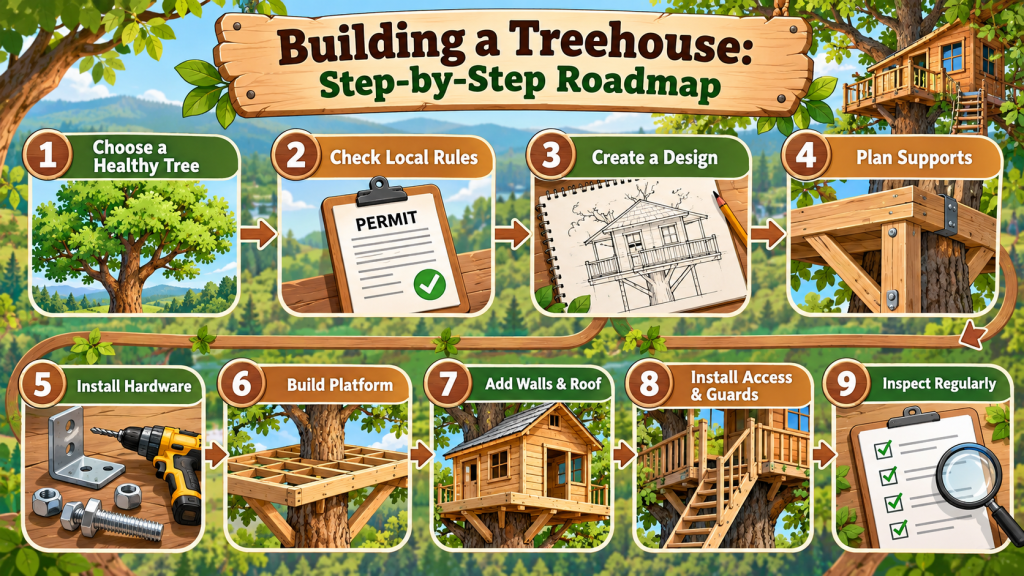
Choose a Healthy Tree and Protect Its Root Zone
A host tree should appear vigorous, without obvious major decay or unstable dead limbs. Species, trunk size, branching, defects, soil conditions, and wind exposure all matter, so appearance alone cannot prove suitability.
When building a treehouse for substantial use, ask a qualified arborist to inspect the tree. During construction, limit vehicles, material piles, and digging near important roots because compaction and root damage can affect long-term health and stability.
Check Permits, Setbacks, and Local Rules Before You Cut
Treehouses can be treated differently depending on size, height, utilities, location, and local rules. Before buying structural materials, ask your building department how your proposed structure is classified.
Also check setbacks, easements, neighborhood rules, and requirements for electrical work. Building a treehouse first and checking later can mean redesigning work you already paid for.
Pick a Layout That Matches the Trees You Have
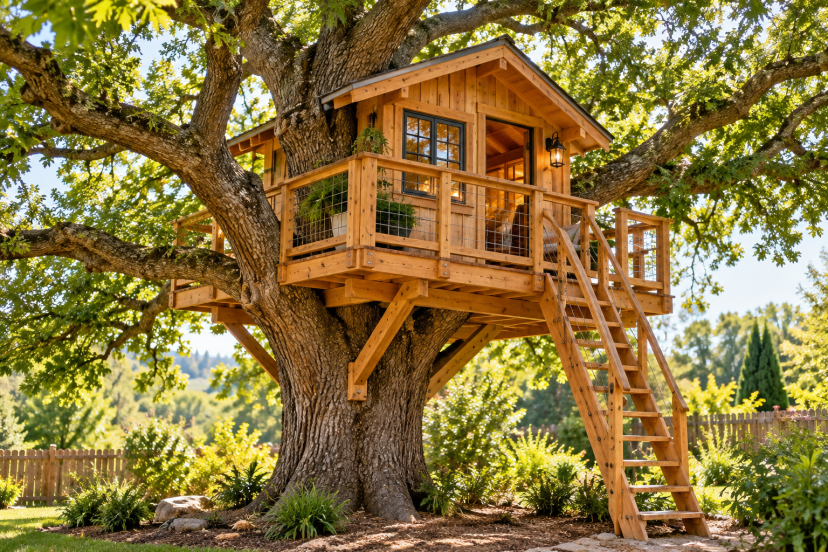
Start with the site rather than copying a photo. A single-tree platform, a span between multiple trees, and a hybrid structure supported partly by posts each handle movement differently.
Sketch trunks, major branches, platform dimensions, access, and roof lines first. Before locking in dimensions, compare a few treehouse floor plans to see how different tree configurations change the platform and support strategy.
Plan Loads, Movement, and the Support System
Trees are living supports, not fixed columns. Trunks grow and sway, and separate trees can move independently. The support system must accommodate that movement rather than forcing every connection to act rigidly.
Do not guess at loads or connector capacity. For tall, heavy, multi-tree, snow-loaded, wind-exposed, or frequently occupied structures, involve a structural professional familiar with timber and tree-supported construction.
Choose Treehouse Hardware Without Guessing
Purpose-built attachment hardware can be appropriate when the design calls for it, but hardware is only one part of the system. Tree condition, attachment location, beam geometry, backups, and installation all affect the connection.
Do not substitute ordinary deck screws for specified structural connectors or treehouse attachment bolts. When building a treehouse from a plan or hardware system, follow its documented installation method instead of mixing unrelated components.
Build the Platform Level, Stiff, and Drainable
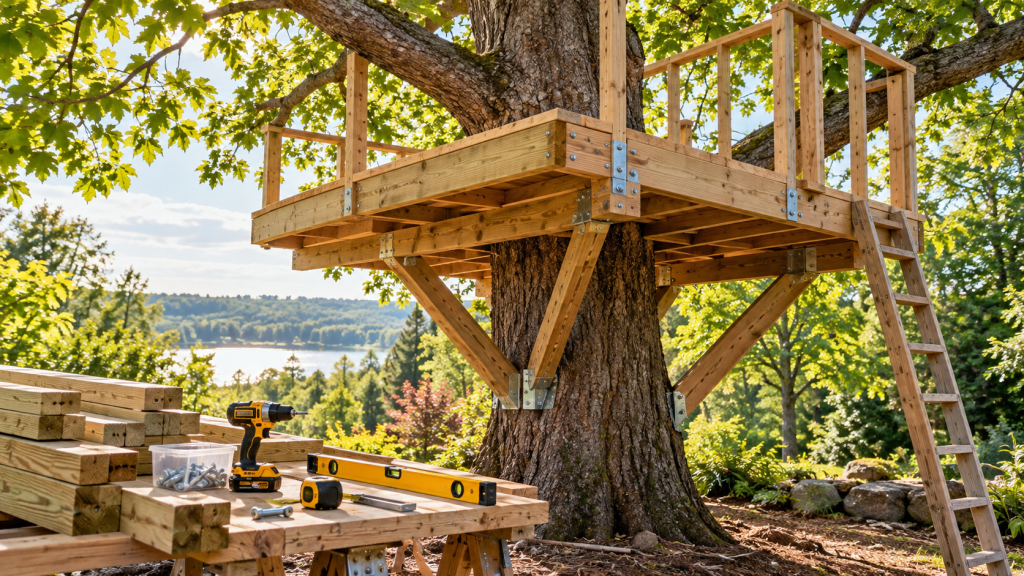
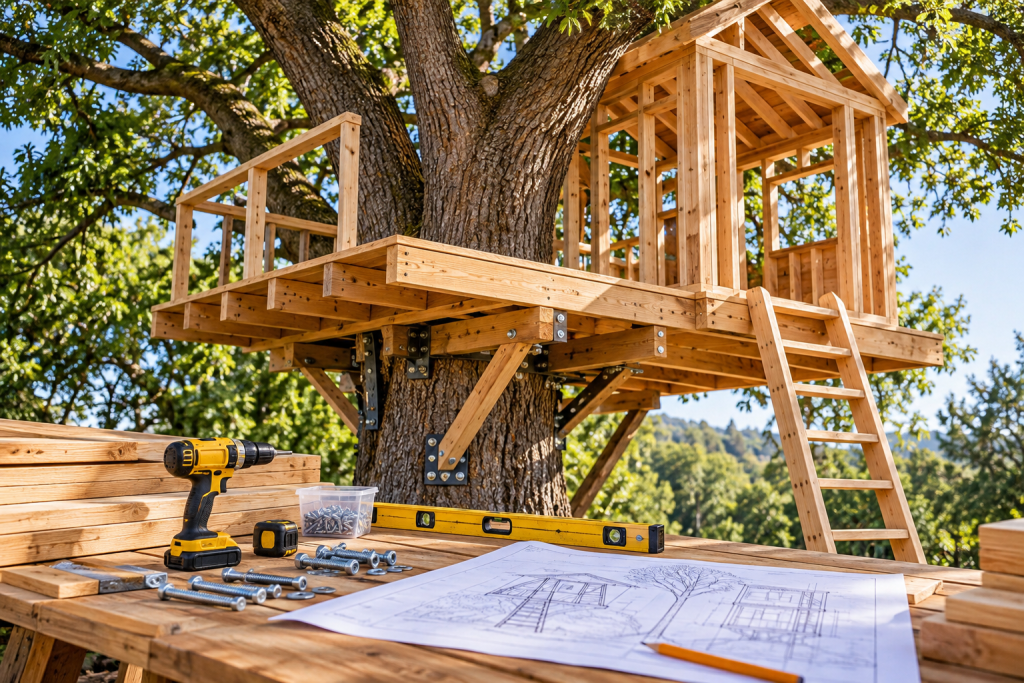
When building a treehouse, the platform deserves extra time. Establish a dependable level reference, install the primary supports, then frame joists and decking according to the chosen plan. Check square repeatedly rather than expecting walls to hide an uneven base.
Outdoor decking also needs to shed water and dry. Follow the required board clearances, and leave adequate space around trunks so growth does not turn the tree into a wedge against the platform.
Frame Walls and a Roof Without Fighting the Tree
Once the platform is stable, keep the upper structure straightforward. Lightweight framing and a simple roof reduce complexity, while openings around trunks and limbs allow room for growth and movement.
Where roofing surrounds a trunk, direct water away without rigidly sealing the tree into the building. Keep these areas visible enough to inspect as the tree changes.
Make Access, Guards, and Openings a Priority
Access should match the users’ age and mobility. Provide secure handholds, stable steps or rungs, and a clear transition onto the platform. For children, guard the ladder opening rather than leaving an exposed edge.
Treat guards, openings, protruding hardware, and fall zones as core design features. Avoid loose ropes or cords that can create entanglement hazards, and keep hard obstacles away from likely fall areas.
Choose Outdoor Materials You Can Maintain
Use lumber, fasteners, connectors, roofing, and finishes intended for exterior exposure and compatible with one another. Follow the project plan and product guidance, especially when pairing fasteners with treated lumber.
When building a treehouse, design for future access too. Visible hardware, replaceable deck boards, and reachable drainage details simplify maintenance. Trees move, wood weathers, and connections can loosen or corrode.
Research-Backed Guidance for Building a Treehouse
Treehouse-specific safety research is limited, but the available evidence makes falls a clear concern. A 2009 peer-reviewed U.S. study of pediatric treehouse injuries estimated 47,351 emergency-department-treated treehouse injuries among people 19 and younger from 1990 through 2006. Falls accounted for 78.6% of cases, and fractures were the most common diagnosis at 36.6%. Because the dataset is historical, it should guide risk awareness rather than serve as a current injury rate.
The U.S. Consumer Product Safety Commission’s guidance for home playground equipment highlights fall hazards, surfacing, entrapment, protrusions, structural integrity, installation, and maintenance. It is not a treehouse-specific building code, but those hazard categories are useful when children will use the structure.
Penn State Extension’s guidance on construction-related tree stress also warns that compacted fill soil, heavy equipment around trees, and severed roots can harm tree health and stability.
Meanwhile, the 2024 International Residential Code addresses guards on certain open-sided walking surfaces more than 30 inches above the floor or grade below. Local adoption and treehouse classification vary, so verify requirements with your local authority rather than treating the model code as local law.
Recommended Products for Building a Treehouse
Useful purchases for building a treehouse span planning, layout, drilling, fastening, and specialized attachment hardware. These options serve different stages rather than duplicating the same job.
| Product | Best for | Main role |
| Nelson Treehouse Tree Fort Hardware Kit | Four-tree platforms | Specialized attachment system |
| BLACK+DECKER Treehouses, 3rd Edition | First-time planners | Visual reference |
| DEWALT DCK240C2 Combo Kit | General DIY work | Drilling and fastening |
| BOSCH PRO GLL50-20 | Accurate layout | Level/plumb reference |
| SWANSON S0101 Speed Square | Budget layout | Marking and angles |
| Irwin 1882792 SPEEDBOR Set | Wood fastening prep | Pilot holes/countersinks |
Nelson Treehouse Tree Fort Hardware Kit – 4 Tree Attachment Bolts, 3 Dynamic Uplift Arrestors, 1 Static Uplift Arrestor, 4 Hex Nuts, 1 Installation Kit
Best for: A small four-tree platform designed around the Tree Fort system
The kit combines four Tree Fort attachment bolts with dynamic and static uplift components, nuts, and an installation kit. It suits a compatible four-tree design rather than improvised connections. The maker recommends additional backup hardware based on the design, so this specialized kit should not be mistaken for a complete structural plan.
Black & Decker The Complete Photo Guide to Treehouses 3rd Edition: Design and Build Your Dream Treehouse
Best for: First-time builders who want a visual planning reference
This 2022, 224-page guide covers tree selection, planning, platforms for different tree arrangements, walls, railings, roofs, and access. Step-by-step photography helps readers visualize the construction sequence before buying lumber. However, a general book cannot account for your exact tree, site, loads, or local building requirements.
DEWALT 20V MAX Cordless Drill and Impact Driver, Power Tool Combo Kit, Includes 2 Batteries, Charger and Bag (DCK240C2)
Best for: DIYers who want separate tools for drilling and fastening
This kit pairs a compact 1/2-inch drill/driver with a 1/4-inch impact driver, two 1.3 Ah batteries, a charger, and a bag. Separate tools reduce bit swapping during framing. The drill has a two-speed transmission, although specialized treehouse-hardware holes may require different bits or equipment.
BOSCH PRO GLL50-20 Self-Leveling Cross-Line Laser
Best for: Establishing level and plumb reference lines
The GLL50-20 projects horizontal and vertical red lines, has a listed 50-foot range, and works with two AA batteries. Its integrated magnetic mount helps create repeatable layout references around framing. A laser improves alignment, but it cannot tell you whether trees, beams, fasteners, or connections are structurally adequate.
SWANSON Tool Co S0101 7 Inch Speed Square, Blue
Best for: Budget-conscious builders doing repetitive layout
This seven-inch aluminum speed square functions as a try square, miter square, and saw guide, and it includes Swanson’s pocket Blue Book. It is compact and useful for marking framing cuts. Its short size means it complements rather than replaces a longer level, straightedge, or laser for full-platform layout.
Irwin Tools 1882792 SPEEDBOR Countersink Wood Drill Bit, 8-Piece
Best for: Pilot holes and countersinking in wood framing
This eight-piece set uses tapered drill bits and adjustable counterbores to create pilot holes and countersinks in one operation, with a 1/4-inch quick-change shank. It can speed repetitive wood fastening, but it does not replace the large specialty auger or Forstner bits required by some treehouse attachment systems.
Common Mistakes That Make Treehouse Projects Harder
Many expensive mistakes begin before framing: choosing a questionable tree, copying dimensions from another yard, ignoring movement between trunks, or buying hardware before finalizing the support plan.
During construction, avoid trapping trunks tightly, concealing connections you need to inspect, or adding heavy features without reconsidering the load path. Afterward, keep checking the tree, platform, guards, access, and visible hardware as conditions change.
Building a Treehouse FAQ
How high should a treehouse be?
There is no universal ideal height. Keep the platform only as high as needed for the intended users and experience, because greater height increases fall consequences and complicates access. Local rules may also affect guards and permits. For children, a lower platform with good visibility and a well-planned fall area is generally easier to supervise and maintain.
Can I build a treehouse without damaging the tree?
You can reduce unnecessary damage, but attaching a structure to a living tree is not impact-free. Minimize poorly planned penetrations, protect the root zone from compaction and excavation, and allow room for growth. For a substantial project, have an arborist assess the host tree and follow a purpose-designed attachment plan.
Do I need special bolts when building a treehouse?
Not every design uses the same connections. Some structures use purpose-built treehouse attachment bolts, while others rely partly or entirely on posts. Do not choose bolts by appearance or substitute ordinary fasteners for specified connectors. Use the hardware called for by a proven plan, manufacturer documentation, or project-specific structural design.
Can I use pressure-treated lumber for a treehouse?
Pressure-treated lumber is commonly used outdoors, but suitability depends on the member, exposure, and local requirements. Choose lumber rated for its intended application and compatible fasteners or connectors. Follow current manufacturer guidance for cutting, handling, sealing, and disposal, especially because treatment formulations and recommendations can differ among products.
How often should I inspect a treehouse?
Inspect it regularly and after severe weather or noticeable tree movement. Look for loose or corroded hardware, cracked wood, damaged guards, worn access points, trapped moisture, and reduced clearance around growing trunks or limbs. Also watch for dead branches, decay, or root-area changes. If a structural condition looks uncertain, stop use until a qualified professional evaluates it.
Final Recommendation for Building a Treehouse
Building a treehouse goes more smoothly when structural decisions come before decorative ones. Start with a healthy tree and realistic layout, confirm local requirements, plan for movement, use compatible exterior materials, and treat access and fall protection as core design elements.
For first-time planners, the BLACK+DECKER photo guide can turn a vague idea into a clearer sequence, while the BOSCH GLL50-20 can simplify layout. Specialized attachment hardware belongs only in a design that calls for it.
Keep the project proportional to your experience. Build low and simple when practical, and involve an arborist or structural professional when the tree, loads, height, or site makes the design difficult to judge confidently.