Ladders and Ropes for Treehouses: Choosing a Safer Way Up
We may earn a commission for purchases made using our links. Please see our disclosure to learn more.
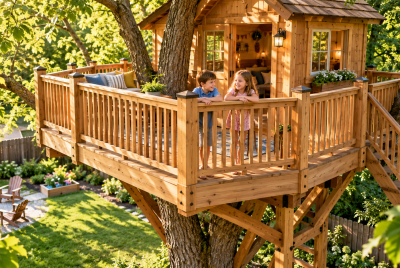
A treehouse can be beautifully built and still have one awkward problem: getting in and out. A shaky ladder or poorly placed opening can make an inviting hideout difficult to use. Choosing the right ladders and ropes is therefore about much more than creating an adventurous entrance.
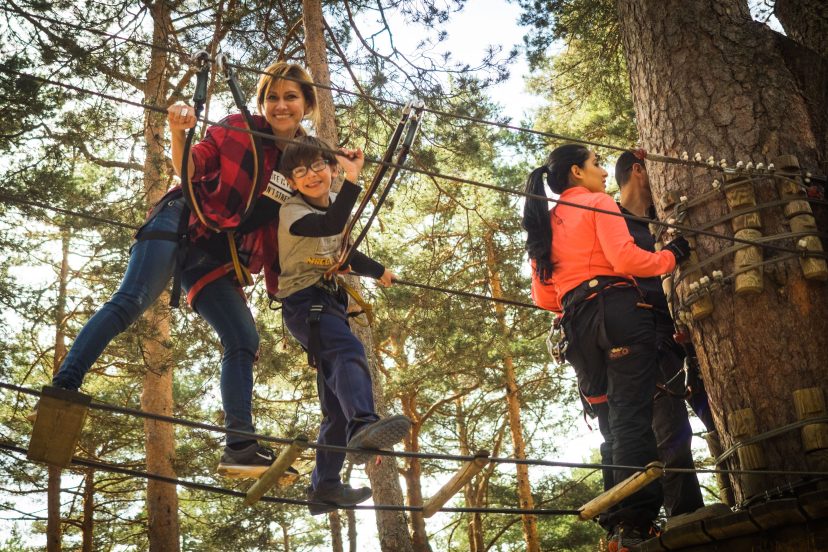
The right setup depends on platform height, users, and frequency. A fixed ladder or stairs usually provides a more dependable main route. Rope accessories can add climbing challenges, but they also bring extra movement and entanglement risks. This guide compares practical access options, explains how to measure and position them, and identifies useful products and safety guidance before you start building.
Choose an Entrance Based on Who Will Use It
Start with the least confident person expected to use the treehouse, not the strongest climber. A child who can race up playground bars may still struggle when stepping from a moving ladder onto a raised deck.
Consider adults carrying supplies and children growing taller. If several people use the treehouse regularly, a stable built-in ladder or staircase deserves priority. Challenging accessories make more sense as optional activities, rather than the only way down.
Fixed Wooden Ladders: The Straightforward Option
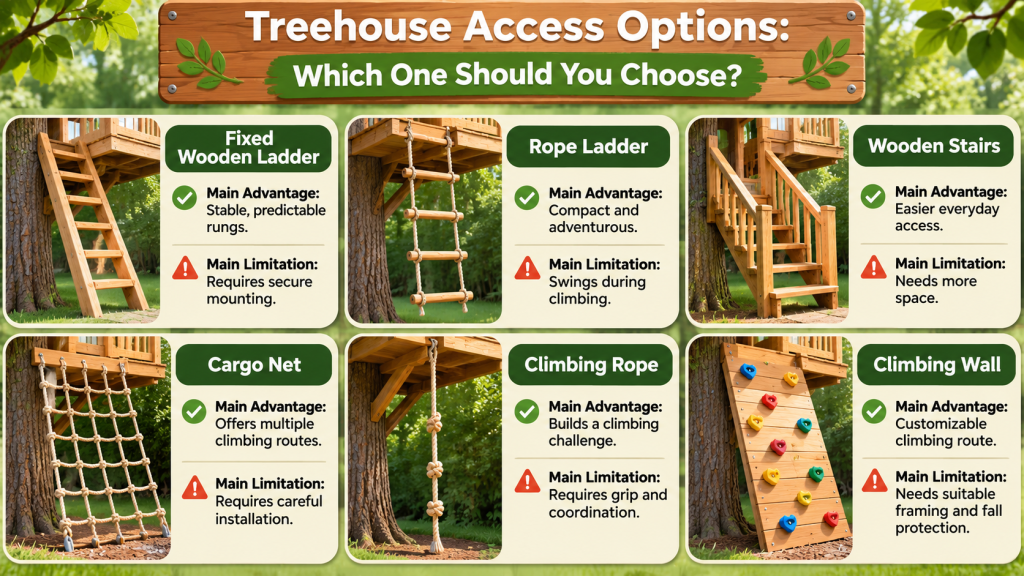
A permanently attached wooden ladder gives climbers predictable rungs and a fixed position. Angling it slightly can make it more comfortable than a near-vertical climb, although the appropriate design depends on available space and structural details.
Choose sound outdoor-suitable lumber, rounded edges, and secure connections. Rungs should remain evenly spaced, including the step onto the platform. A ladder fastened only to decorative siding is not properly supported; its load must transfer into suitable framing. For frequent use, consider handrails or stairs.
Rope Ladders: Adventure With More Movement
A rope ladder combines flexible side ropes with wooden, resin, or other manufactured rungs. It can fit a compact play area and create an appealing climbing challenge, but it swings and twists underfoot. That instability makes it a poor default entrance for younger children or unsure climbers.
An advertised age range cannot establish suitability. Check rung spacing, the manufacturer’s installation method, attachment hardware, and whether lower anchoring is required. In a children’s treehouse, use a rope ladder only as a supervised secondary activity when the entire setup has been assessed for suitability.

Climbing Ropes and Platform Footholds
A vertical climbing rope asks users to support themselves with their hands and feet. Versions with molded footholds provide places to stand, but they still demand coordination and grip. They are recreational challenges, not replacements for stable everyday access.
Loose or improvised hanging ropes pose a serious strangulation hazard. A climbing rope must be a purpose-designed playground component, secured at both ends according to its instructions so it cannot form dangerous loops. Keep it away from swings and primary access.
Cargo Nets and Flexible Climbers
A climbing cargo net offers several possible routes across a broad surface. Unlike a ladder, however, its rope grid changes shape as someone climbs. Poorly sized openings create entrapment risks.
Use only a manufactured net intended for playground climbing, installed with its specified upper and lower attachments. Net-opening dimensions require particular attention because head and neck entrapment can be serious. Avoid adapting a decorative cargo net, barrier net, or general-purpose hauling net for children to climb.
When Stairs Beat Ladders
Stairs take more space, material, and construction time, but they are often the better solution for a frequently used treehouse. Broader treads and continuous handrails can make the climb more manageable for visitors who dislike vertical ladders.
A ship-style stair or compact stairway may offer a middle ground where a conventional staircase will not fit. It still needs an appropriate rise, tread depth, handrail arrangement, and landing. Have a qualified builder check the design against local requirements.
Pick Materials That Suit Outdoor Exposure
Outdoor ladders face rain, sun, shifting temperatures, and repeated wet-dry cycles. Wood should be appropriate for exterior use, with smooth contact surfaces and no splitting around fasteners. Rust-resistant metal is useful for some brackets and handles, provided it is compatible with the lumber and exposure.
Rope materials tell only part of the story. Construction, ultraviolet exposure, abrasion, manufacturer limits, and installation matter too. Do not substitute ordinary hardware-store cord or utility rope for a tested playground component.

Measure the Height and Plan the Climbing Route
Measure the vertical distance from the finished ground surface to the actual point where feet enter the platform. Then check the ladder’s installed angle, total length, rung positions, and clearance in front. A hanging ladder that stops short of the ground can leave climbers searching for a foothold.
Plan the entrance before cutting. Make sure children can step onto a full, secure landing without leaning around a post or climbing over a barrier. Allow enough space for an adult to supervise from below without standing directly underneath another climber.
Secure Anchors and the Platform Transition
A climbing accessory is only as dependable as its supporting frame and connections. Check whether the manufacturer specifies a beam, mounting bracket, strap, connector, or other dedicated fixing point. Neither a tree branch nor porch trim is automatically a suitable anchor.
The upper transition deserves special attention: a child needs stable footing and something solid to grasp while moving onto the deck. Purpose-made grab handles may help, but they do not replace protective barriers. For a broader inspection checklist, see these treehouse safety tips.
Protect the Ground Beneath Every Climbing Area
Plan the landing zone before adding a climbing feature. Concrete, rocks, exposed roots, and hard-packed ground make falls more dangerous. Grass alone is not reliable protective surfacing because its cushioning changes with wear and weather.
Use appropriate playground surfacing beneath and around access equipment, following the relevant fall-height guidance and the product’s instructions. Keep the area clear of sharp edging and protruding anchors. Without a suitable fall zone, choose a lower, simpler entrance.
Teach Climbing Rules and Inspect the Equipment
Even a sturdy installation needs regular attention. Before children climb, look for movement at the anchors, frayed strands, cracked rungs, loose fasteners, splinters, and corrosion. Recheck after storms and heavy use.
Set a few practical rules: one climber at a time, hands free of toys, suitable shoes, and no jumping from the platform. Remove bicycle helmets and clothing with drawstrings before play because they can snag. Stop access when the structure is wet, damaged, or inadequately supervised.
Recommended Ladders and Ropes Accessories for Treehouses
These accessories offer climbing challenges or extra handholds, not substitute primary access.
Trailblaze Wooden Rope Ladder for Kids – 6ft Outdoor Climbing Ladder
Best for: A traditional-looking secondary climbing feature.
This six-foot ladder uses beechwood rungs, polyester rope, and two carabiners, giving a familiar wooden foothold within a flexible design. Its rustic appearance suits a timber play fort. Because the ladder can move underfoot, check mounting compatibility and clearance carefully; choose fixed access for children who need a steadier climb.
Cateam Wooden Rope Ladder for Kids with Ground Anchoring
Best for: A rope-ladder activity where reduced swinging matters.
This approximately 6.5-foot model features hardwood rungs, double-knot construction, and supplied ground-fixing components. Lower attachments may reduce movement when installed correctly. Ground anchors introduce their own trip and impact considerations, so follow the instructions and keep fittings covered by appropriate protective surfacing.
Swing-N-Slide WS 4481 Climbing Cargo Net for Kids
Best for: A dedicated climbing-net area beside a play platform.
The WS 4481 uses a rope-and-wood climbing-net design intended for playsets. Its wider climbing surface offers a different challenge from a single ladder. It needs suitable framing, bottom attachment, and clearance. Check the installed opening dimensions and use it as an activity, not an improvised protective barrier.
Squirrel Products 6.5 ft Climbing Rope with Platforms
Best for: A compact, supervised climbing challenge.
This 78-inch climbing rope includes five half-round footholds and a metal hanging ring, making it narrower than a full cargo net. The platforms provide intermediate places for feet, but users still rely on balance and grip. Install only as the manufacturer permits, ensuring the rope cannot create an entanglement hazard or become the sole route down.
TOPNEW 32 Rock Climbing Holds Multi Size for Kids and Adults
Best for: Creating a customizable climbing wall for a treehouse.
This set includes 32 textured resin climbing holds in different shapes and sizes, along with bolts, washers, weld nuts, and an installation wrench. It works well for adding a climbing-wall activity beside a treehouse. The included hardware accommodates wooden panels up to 1¼ inches thick, so check your wall’s construction and provide appropriate fall protection.
What Safety Guidance Reveals About Treehouse Access
The U.S. Consumer Product Safety Commission’s Outdoor Home Playground Safety Handbook identifies falls, entrapment, and hanging ropes as major hazards. It recommends evenly spaced climbing elements, protection against dangerous openings, securing both ends of climbing ropes as directed, and impact-absorbing surfacing. Its guidance concerns residential playground equipment rather than providing a complete structural design code for treehouses.
A 2025 safety guide from Nationwide Children’s Hospital favors built-in steps or ladders over ropes or chains for access because of strangulation concerns. That supports treating flexible rope equipment as an optional activity rather than your main entrance.
The CPSC also warns in its cargo-net safety alert that certain net openings can trap children’s heads. These are hazard-prevention recommendations, not proof that any specific product or installation is safe. Verify each component and the entire build before use.
Frequently Asked Questions About Ladders and Ropes
Is a rope ladder suitable as the only treehouse entrance?
Generally, no for a children’s treehouse. Rope ladders move and can be harder to descend than they appear. Injury-prevention guidance favors fixed steps or built-in ladders as the normal route. If you want a rope ladder for play, provide stable independent access and supervise the activity.
How do I know what length ladder to buy?
Measure from the finished ground to the exact entry point, then account for the installed angle and attachment geometry. Check the product’s specified installed length rather than relying on the package name. The top step must allow a controlled transfer onto the deck, without an unusually large final gap.
Can I tie a climbing rope directly to a tree branch?
Do not assume a branch is an appropriate anchor. Its condition, movement, and load capacity require competent assessment, while the rope product may specify an entirely different support system. Never improvise with loose hanging ropes in a children’s play area. Follow the manufacturer’s attachment and end-securing instructions.
Are wooden rungs better than plastic ones?
Neither material is automatically safer. Wooden rungs can provide a familiar feel but may splinter or deteriorate without maintenance. Molded plastic can be easy to clean, yet it may crack or become slippery. Compare grip shape, spacing, manufacturer limits, outdoor durability, and the complete installation instead of choosing by appearance.
How often should treehouse climbing equipment be checked?
Give it a quick visual check before each play session, especially after rain or strong wind. Schedule closer inspections of fasteners, ropes, wood, and anchor points throughout the season, following manufacturer recommendations. Remove damaged equipment from service immediately; fraying or a loose rung is not something to postpone repairing.
Conclusion: Make Reliable Access the First Priority
The best ladders and ropes for a treehouse are the ones that fit the people using it, the platform layout, and the available landing space. A fixed wooden ladder or properly designed stairs generally makes the most sense for everyday entry. Rope ladders, climbing ropes, and cargo nets can add variety, but they require appropriate anchoring, fall protection, and supervision.
A Trailblaze ladder may suit a separate climbing challenge, while Swing-N-Slide handles can support a carefully designed fixed entrance. Neither accessory makes up for weak framing or an unsafe platform transition. Start by choosing and checking your primary access route, then add optional climbing features only where the structure, surroundings, and manufacturer instructions support them.