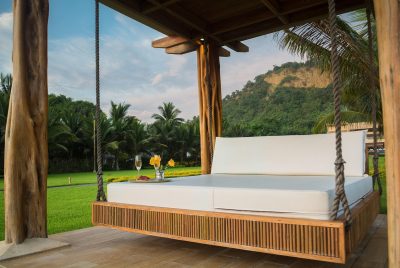
Daybed Swing Hanging Tips for a Safe, Level Install
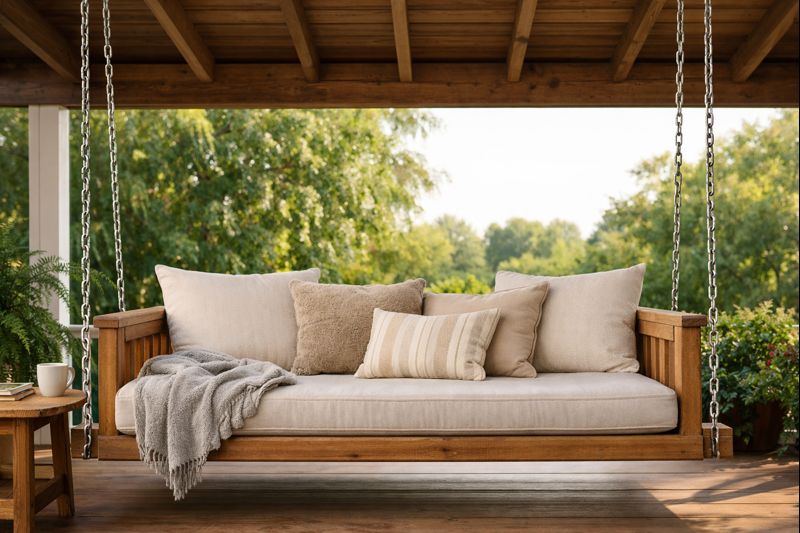
We may earn a commission for purchases made using our links. Please see our disclosure to learn more.
If you’ve ever sat on a porch swing and thought, “Okay… but what if I could lie down right now?”—you’re already emotionally ready for a daybed swing.
A daybed swing is basically the cozy middle ground between a hammock and a real bed: it looks gorgeous, it feels like a slow exhale, and it instantly makes your patio/porch/backyard feel like a staycation. But yes… hanging one can feel intimidating. (Because gravity is consistent, and it has zero chill.)
In this guide, I’ll walk you through how to pick the right setup, choose safe hang points, get a level install, and keep your swing steady and comfy.
Affiliate note: If you buy through the product links, you may support the site at no extra cost to you.
Why a daybed swing feels like a mini vacation
A daybed swing changes the vibe fast. It signals: slow mornings, iced coffee, soft pillows, and “I’m not rushing today.”
It’s also one of the rare outdoor pieces that works for:
- quick solo breaks (“5 minutes” that turns into 40)
- family lounging
- reading, napping, scrolling, stargazing
- hosting (people always gravitate toward it)
If your outdoor space feels “nice but unused,” a daybed swing is often the missing magnet.
Porch swing bed vs hanging daybed: what are you actually buying?
People say “daybed swing” and might mean two different things:
Hanging daybed swing
This is the classic: a swing bed suspended from a porch ceiling, pergola, or beam. It’s the floating look everyone saves on Pinterest.
Swing bed with a stand
This is the “no ceiling needed” option. It still swings, but the frame does the heavy lifting (literally).
If you rent, don’t want structural work, or your porch ceiling is a question mark… a stand-based swing bed can be the smarter, lower-stress route.
Measure first: space, clearance, and the “kick zone”
Before you fall in love with a specific daybed swing, grab a tape measure and check:
- Width: leave at least 12–18 inches of breathing room on both sides
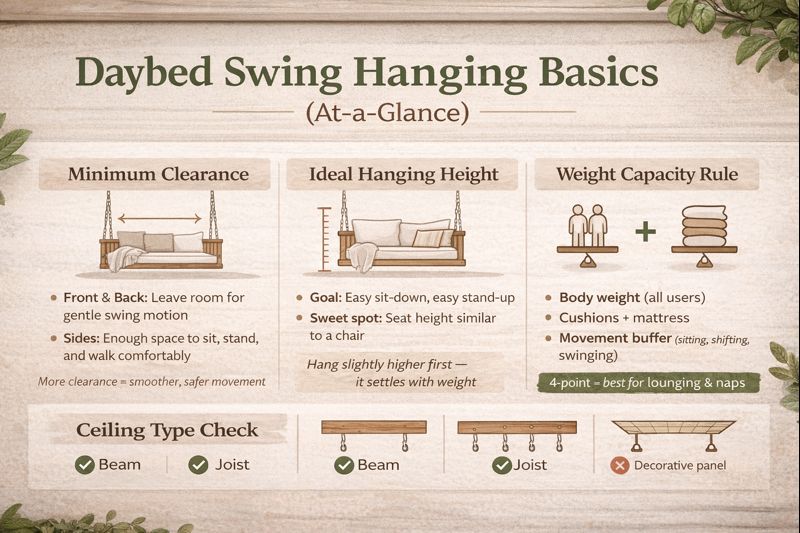
- Front/back clearance: you want enough space so it can swing without bumping rails, walls, or plants
- “Kick zone”: the swing moves forward and back—make sure it’s not kicking into a coffee table, fire pit, or foot traffic path
A quick mental test: If this swings while someone is carrying a drink… do we lose the drink?
Weight capacity without the math headache
This part matters. A porch swing bed isn’t like a decorative chair—people will pile on.
A simple, practical approach:
- Think “max people + pillows + movement.”
- Then add a buffer, because swinging adds dynamic force.
If you’re unsure, treat it like buying a ladder: overbuild your safety margin.
And if your setup involves older wood, unknown beams, or DIY framing… consider a pro consult. A 10-minute opinion can prevent a very expensive, very un-fun surprise.

Pick the best hang point: joists, beams, and roof reality
Your daybed swing is only as safe as what it’s hanging from.
Best-case scenario:
- a solid beam designed for load
- properly supported joists
- a structure that’s in good shape (no rot, no cracks, no “this has been here since 1972” mystery wood)
If you’re installing into a finished ceiling, the goal is to anchor into the structural member, not just pretty boards.
When in doubt, don’t “hope it’s fine.” Verify it.
Hardware basics: chains, rope, springs, and why “rated” matters
A daybed swing install is not the place for random hooks from a junk drawer.
Look for hardware that’s load-rated for swinging/hanging (not just “decorative”).
Common parts you’ll see:
- heavy-duty eyebolts or swing hangers
- chains or marine-grade rope
- quick links/carabiners (rated)
- optional springs (for bounce + comfort)
The vibe you want is: quiet, steady, strong, not squeaky and sketchy.
Two-point vs four-point hanging: which feels better?
This is a comfort thing and a stability thing.
Two-point hanging
- simpler
- slightly more “swingy”
- can twist more easily if the weight shifts
Four-point hanging
- more stable
- helps reduce twisting
- can feel more “bed-like” and level
If you want that “floating daybed” feel that doesn’t spin every time someone sits down—four-point is usually your friend.
How to hang a daybed swing level (without losing your mind)
A level daybed swing looks expensive and feels safe. A crooked one feels like you’re slowly sliding into regret.
Here’s the approach that saves sanity:
Step 1: Hang it slightly high at first
It will settle once weight hits it.
Step 2: Use matching chain lengths (or measured rope)
Don’t eyeball it. Measure.
Step 3: Level the frame, then test with weight
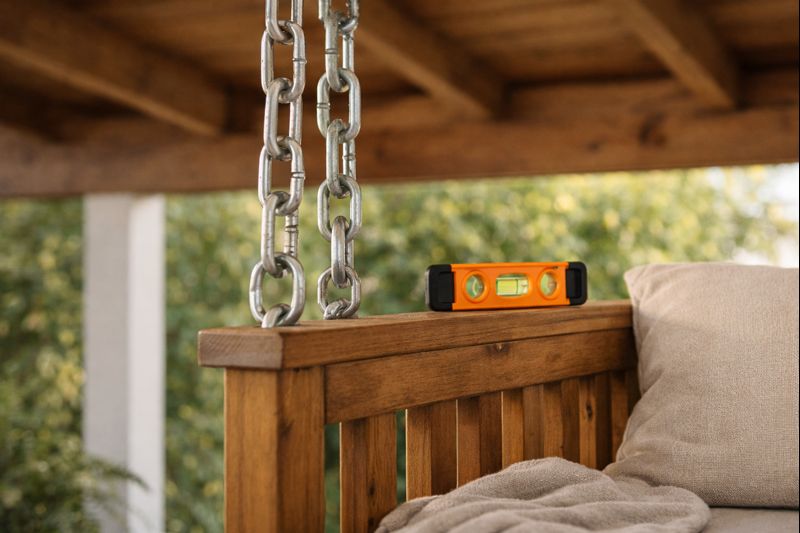
Use a level tool on the swing frame. Then sit gently and re-check.
Step 4: Micro-adjust one side at a time
Tiny changes matter. One link can fix the whole thing.
Pro tip: mark your “perfect link” position once you find it. Future-you will thank you.
How to stop sway, twist, and side-to-side wobble
If your daybed swing feels like it’s doing interpretive dance, a few tweaks usually fix it:
- Switch to four-point hanging (if you’re on two-point)
- Add spreader bars (depending on design)
- Check anchor spacing (too close = more wobble)
- Add a little weight (a mattress + cushions can stabilize)
- Reduce wind exposure if possible (screens, curtains, placement)
Also: uneven ground or a slightly off-center mount can create a constant “pull” that makes the swing misbehave.
Cushion and mattress choices: cozy, not clunky
A daybed swing can be “oh wow, I never want to stand up again”… or it can be “why does this feel like a gym mat?”
A few comfort rules that work:
- Foam mattress for real lounging (especially for napping)
- Outdoor-rated cushions if it’s exposed to humidity/rain
- Textured throws + pillows for that inviting look (and back support)
If your swing is in a covered porch, you have more flexibility. If it’s open to weather, go more durable and less precious.
Weatherproofing: rain, sun, rust, and fabric drama
Outdoor furniture fails for boring reasons: water sits, sun bakes, and metal rusts.
To keep your daybed swing looking good:
- choose finishes meant for outdoors (or seal wood properly)
- store cushions during heavy rain weeks
- use quick-dry covers
- check metal for early rust spots and treat fast
If you live somewhere humid, prioritize breathable fabrics and don’t trap moisture under plastic covers for days. (That’s how mildew moves in like it pays rent.)
Safety checks and a simple maintenance routine
This takes 5 minutes and prevents 95% of problems:
Monthly:
- check chains/rope for wear
- tighten anything that loosens
- listen for new squeaks (they’re clues)
Seasonally:
- inspect the ceiling/beam area
- look for wood cracks, corrosion, or shifting
- re-level if needed
If it’s a high-use swing (kids, guests, daily naps), treat it like a “working” piece—not a decoration.
Kid- and pet-friendly setup (without killing the vibe)
You can have a beautiful daybed swing and keep it practical.
A few real-life tips:
- keep swing clearance away from sharp corners and fragile decor
- avoid long dangling chains where little hands can pinch
- use grippy rugs or non-slip mats nearby (especially if kids jump off like it’s a stage)
Also, if you have pets: expect fur. Choose washable covers and lean into it. The swing will become their throne.
Product picks: 5 daybed swing options
1) Malvern 5 Foot Wood Porch Swing Bed (Amish Handcrafted Daybed Style Swing)
Short description: A classic wood porch swing bed with that timeless “front-porch novel” look.
Features:
- solid wood build (traditional swing-bed style)
- daybed-like lounging shape
- a statement piece for covered porches
Best for: You want the iconic hanging porch swing bed look and you love natural wood warmth.
2) Amish Casual “The Philly” 6 Foot Porch Swing Bed (Modern Backrest)
Short description: A bigger swing-bed style with a more modern backrest profile.
Features:
- longer 6-foot size (more stretch-out room)
- structured backrest design
- made to look “designed,” not just functional
Best for: You want a larger daybed swing feel and a slightly more modern aesthetic.
3) Merax 80″ Acacia Wood Porch Swing Bed (Twin Size)
Short description: A twin-size acacia swing bed vibe—great if you want room to lie down.
Features:
- acacia wood look (warm, modern-natural)
- wider lounging footprint
- strong visual centerpiece
Best for: You want a daybed swing that feels closer to an actual bed for naps.
4) Outdoor Full Size Hanging Porch Swing Bed (Acacia Wood, Open-Side Frame)
Short description: A full-size hanging swing bed profile with an open-side design.
Features:
- bigger lounging area
- open-side frame (airy look)
- works well with layered pillows
Best for: You’re building a “porch lounge” moment and want maximum sprawl space.
5) Best Choice Products 3-Seat Outdoor Converting Canopy Swing Glider (Flatbed)
Short description: Not a hanging daybed—but a super practical swing bed that converts from sitting to reclining with a canopy.
Features:
- converts into a flatbed-style lounger
- built-in canopy for shade
- great “family patio” functionality
Best for: You want the daybed swing experience without ceiling installation stress.
Bonus comfort tip: If you’re putting a daybed swing outdoors, you’ll also want to keep the lounging zone comfortable and protected—especially from bugs and small critters. This quick guide on pest-proofing your outdoor space is a helpful add-on when you’re setting up your swing area.
Research-backed: why gentle swinging helps you unwind
This is the part where your daybed swing becomes more than “cute patio furniture.”
A 2019 study in Current Biology found that gentle rocking can support deeper sleep and improve sleep stability in healthy sleepers (and it even explored effects on memory consolidation). Here’s the source: rocking bed sleep study (Current Biology, 2019).
More recently, a 2024 clinical study on a rocking bed looked at people with persistent severe sleep disorders and suggested rocking-bed style vestibular stimulation may help improve sleep outcomes for some patients (with the usual “more research needed” caveat). Source: rocking bed sleep disorders study (2024).
No, your porch daybed swing isn’t a medical device. But the bigger takeaway is simple and kind of lovely: gentle motion can help your brain downshift. That’s probably why you feel calmer after 10 minutes on a swing—even if you didn’t “do” anything.
Daybed swing FAQs
Is a daybed swing safe to hang from a porch ceiling?
Yes—if the structure is truly load-bearing and you use properly rated hardware. When you’re unsure about beams/joists, get a pro opinion instead of guessing.
What’s the best hanging style: 2-point or 4-point daybed swing?
If you want the most stable, non-twisty feel, 4-point hanging usually wins. Two-point can feel more “swingy” but may twist more.
How do I keep my daybed swing from tilting to one side?
Measure chain/rope lengths, level the frame before final tightening, then test with weight. Small adjustments (even one chain link) can fix a stubborn tilt.
Can a daybed swing stay outside in the rain?
The frame might handle it, but cushions usually shouldn’t. If your setup isn’t fully covered, plan on outdoor-rated materials, covers, and bringing cushions in during heavy rain.
What size daybed swing should I buy for a small porch?
Look for compact swing beds (4–5 ft) and keep clearance in mind. If you’re tight on ceiling structure or space, a stand-based swing bed can be easier.
If you want a daybed swing that feels like a “yes” every time you step outside, focus on three things: a safe hang point, a level install, and comfort you actually use. Once those are right, the rest is just styling—pillows, throws, maybe a little side table for your drink (because we’re not savages).
You’re not just installing furniture. You’re building a tiny daily escape.