How To Design A Multi-Level Treehouse
We may earn a commission for purchases made using our links. Please see our disclosure to learn more.
Designing a Multi-Level Treehouse sounds dreamy until you start asking real questions. How high is too high? Where should the ladder go? Can kids play safely while adults still enjoy the space? And how do you make it feel magical instead of messy?
A great treehouse is not just a platform nailed to a tree. It is part play fort, part outdoor room, part memory machine. In this guide, you’ll learn how to plan the layout, choose safe features, create cozy zones, and add practical treehouse accessories without turning your backyard into a construction headache.
Disclosure: This article includes Amazon product suggestions, so your site may earn a commission if readers buy through links.
What Makes a Multi-Level Treehouse Special?
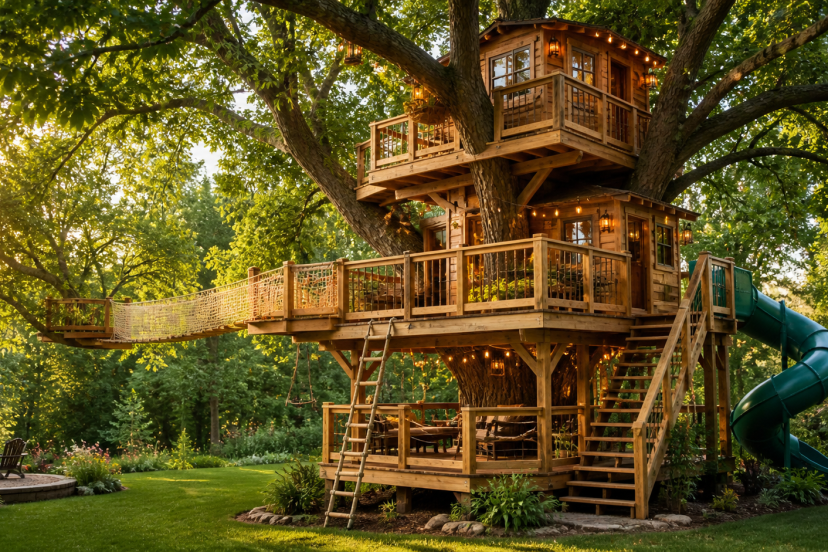
A single-level treehouse gives you a perch. A Multi-Level Treehouse gives you a tiny adventure.
Each level can serve a different purpose:
- A lower deck for younger kids
- A middle platform for reading or snacks
- An upper lookout for big-kid imagination
- A side bridge, ladder, or slide for movement
Think of it like a mini mountain village. The charm comes from variety. Kids can climb, pause, peek, pretend, and explore. Adults get that “I would’ve loved this as a kid” feeling, which is honestly half the fun.
Start With The Tree And The Yard
Before you sketch treehouse plans, study your yard.
Look For A Healthy Support Tree
Choose a strong, mature tree with a thick trunk and healthy branches. Oak, maple, beech, and fir are common choices, but the right tree depends on your region.
Avoid trees with:
- Deep cracks
- Dead limbs
- Fungal growth
- Hollow sections
- Weak or leaning trunks
If you feel unsure, call an arborist. That small step can save you from a very expensive “oops.”
Decide Who The Treehouse Is For
A kids treehouse needs different choices than an adult garden hideout.
Ask yourself:
- Will toddlers use it?
- Will older kids climb and hang out there?
- Do adults need seating?
- Is it for play, reading, sleepovers, or photos?
- Will it be used year-round?
For mixed ages, keep the lower level simple and safer. Then reserve higher sections for supervised older kids or adults.
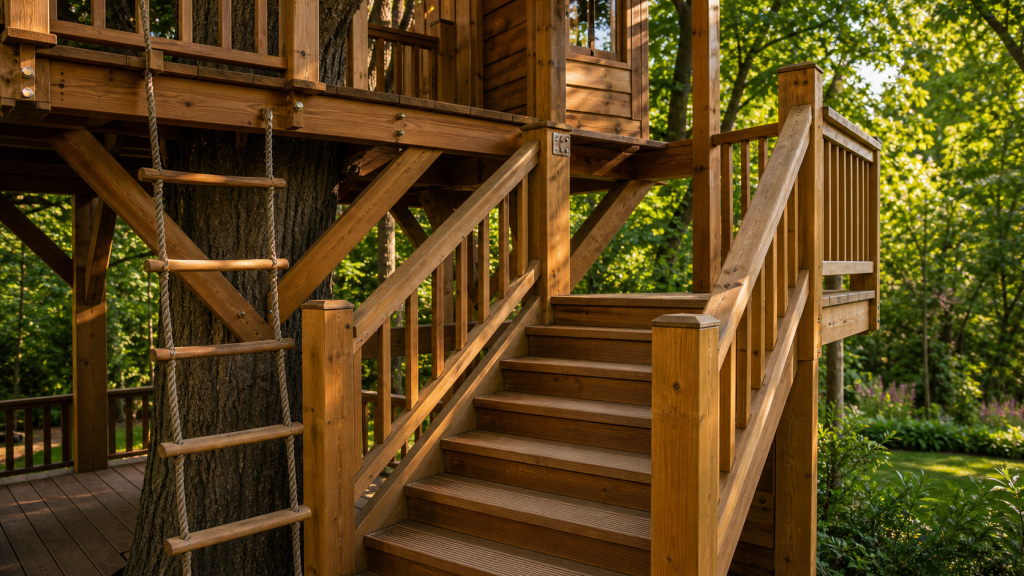
Map The Levels Like A Tiny Home
A good backyard treehouse design needs flow. You do not want random platforms stacked like pancakes.
Try this layout:
Lower Level
Use this as the entry deck. Add wide steps, a small bench, or a little mudroom-style cubby.
Middle Level
Make this the main hangout. It can hold seating, a small table, or a pretend kitchen.
Upper Level
Use this as the lookout. Keep it simple with secure railings, a telescope, or a reading nook.
Each level should feel useful. If a platform has no purpose, it becomes wasted lumber with a nice view.
Keep Safety At The Center
Treehouse safety is not the boring part. It is what lets everyone relax.
Nationwide Children’s Hospital notes that nearly 2,800 children are treated in emergency departments for treehouse-related injuries each year, with many injuries caused by falls or jumps from the structure. Their prevention tips include choosing a sturdy tree, avoiding electrical wires, and keeping treehouses lower rather than excessively high.
Practical safety tips:
- Build lower than your imagination wants
- Use strong railings on every open side
- Add soft landing material below
- Avoid ropes or chains that can wrap around the neck
- Check hardware often
- Supervise younger children
Magic is lovely. Guardrails are lovelier.
Plan Access Before You Build
Your access route controls how people move through the whole elevated playhouse.
Stairs
Best for younger kids, grandparents, and anyone carrying snacks. Snacks matter.
Rope Ladder
Fun and adventurous, but better for older kids with good coordination.
Fixed Ladder
Space-saving, but it should have secure handholds and proper rung spacing.
Climbing Wall
Great for active kids, especially when paired with a lower platform and soft ground below.
The best design often uses more than one access point. A stairway for easy entry and a rope ladder for play gives you both comfort and adventure.
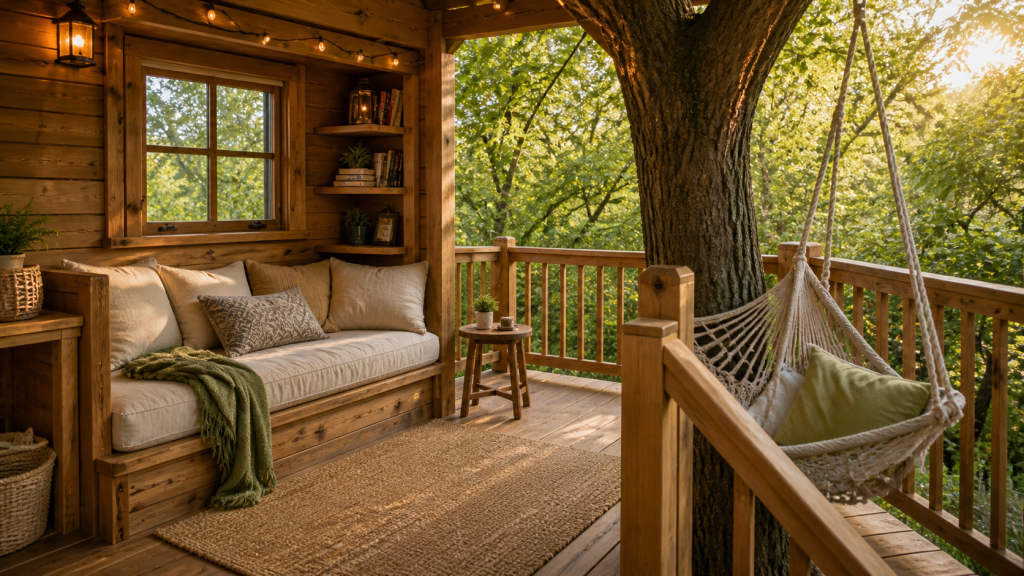
Design Railings, Barriers, And Landings
Railings can still look beautiful. They do not have to feel like a prison fence.
Use:
- Wood balusters
- Cable railing where safe and code-appropriate
- Mesh panels
- Branch-style railings
- Solid half-walls for younger kids
The American Academy of Pediatrics says platforms over 30 inches high for school-aged children should have guardrails or barriers, and it also recommends shock-absorbing surfaces under play equipment.
For a multi-level build, add small landings between transitions. They give kids a pause point and reduce the “straight-shot sprint” energy.
Choose Weather-Smart Materials
A treehouse lives outside full-time, so materials matter.
Make use of outdoor-rated wood, such as cedar, redwood, or pressure-treated lumber. Pick galvanized or stainless steel hardware. Seal the wood properly, especially cut ends and joints.
Avoid slick flooring. Rain, dew, and bare feet can turn a cute deck into a banana peel scene.
Good flooring options include:
- Textured deck boards
- Outdoor mats
- Anti-slip strips
- Drainage gaps between boards
Create Play Zones With Personality
A Multi-Level Treehouse should invite stories. One day it is a pirate ship. The next day, a café. Then a secret library. Kids are basically tiny theater directors with muddy shoes.
Try zones like:
- Lookout deck
- Reading corner
- Snack ledge
- Mini art station
- Pretend shop
- Nature observation spot
- Quiet nook
For a diverse family setup, think beyond one style of play. Some kids love climbing. Some love drawing. Some want a peaceful corner away from noise. A thoughtful design gives different personalities room to breathe.
Add Comfort For Adults Too
If adults will supervise from the treehouse, make space for them.
Add a built-in bench, wider landing, or shaded corner. You can also create a cozy lower-level lounge with a comfortable hanging hammock chair so grown-ups can relax nearby while kids play.
That small comfort upgrade changes the whole mood. Suddenly, supervision feels less like guard duty and more like a backyard retreat.
Use Lighting, Shade, And Cozy Details
Lighting turns a treehouse deck into something magical.
Use soft outdoor lighting, not harsh floodlights. Solar string lights, battery lanterns, and low-voltage path lights work well.
Add shade with:
- Canvas canopy
- Outdoor curtains
- Tree-friendly fabric sails
- Pergola-style roof
- Natural branch cover
Keep fabrics weather-resistant and easy to remove before storms.
Build Storage Into The Design
Treehouses collect stuff. Chalk, toy binoculars, books, sticks, mystery rocks, snack wrappers. The usual backyard archaeology.
Add:
- Small wall hooks
- Weatherproof storage box
- Built-in cubbies
- Bucket pulley system
- Under-bench storage
A storage plan keeps your outdoor play space charming instead of chaotic.
Recommended Products For A Multi-Level Treehouse
1. DIY Treehouse Bucket Pulley Kit For Kids
This bucket pulley kit adds instant charm to a backyard treehouse. Kids can lift toys, notes, snacks, or “important forest supplies” without running up and down the ladder. Amazon lists features like a wide bucket, nylon rope, SUS304 fittings, and a 33-pound capacity.
Features: Bucket, rope, pulley hardware, outdoor-friendly design
Best for: Kids who love pretend play and parents who want less climbing with full hands
2. Climbing Cargo Net, 9.9 ft x 9.9 ft Large Playground Safety Net
A cargo net can work as a climbing feature, side barrier, or adventure bridge element when installed correctly. One Amazon listing describes a polyester double-layer playground safety net for backyard treehouse accessories.
Features: Large net design, polyester material, climbing use
Best for: Active kids, obstacle-style treehouse plans, adventure zones
3. Treehouse Brackets And Hardware – 1.25″ Pipe Suspension Bracket
For serious structural support, proper treehouse hardware matters. Amazon’s treehouse supplies listings include pipe suspension brackets and other hardware designed for treehouse builds.
Features: Powder-coated steel, suspension support, treehouse framing use
Best for: DIY builders working with a contractor or experienced carpenter
4. Squirrel Products 6 ft. Climbing Rope Ladder For Kids
A rope ladder adds classic treehouse energy. It works best as a secondary access route, not the only way up for young children.
Features: Rope ladder design, compact access, active play
Best for: Older kids, backyard playsets, lower treehouse decks
5. Brightech Ambience Pro Solar Powered Outdoor String Lights
Soft lighting makes the treehouse feel cozy after sunset. Search results for outdoor string lights include Brightech Ambience Pro solar-powered options, which are popular for patios and outdoor spaces.
Features: Solar power, warm outdoor lighting, patio-style look
Best for: Reading corners, lower decks, evening hangouts
Research-Backed Design Notes
A Multi-Level Treehouse is more than a backyard play structure. When planned well, it can support movement, imagination, problem-solving, and outdoor confidence. Research from the National Association for the Education of Young Children explains that outdoor play supports children’s physical, social, and cognitive development by giving kids space to explore, observe, take age-appropriate risks, and interact with nature in hands-on ways.
That matters because a treehouse naturally invites active learning. Kids climb, balance, measure distance, create pretend worlds, and negotiate shared space. A lookout deck can become a bird-watching station. A rope ladder can build coordination. A pulley bucket can turn into a simple engineering lesson without feeling like schoolwork.
Safety research also gives clear guidance. The American Academy of Pediatrics notes that falls are one of the most common causes of playground injuries and recommends safe surfacing, proper barriers, and age-appropriate equipment. For a Multi-Level Treehouse, that means sturdy railings, shock-absorbing ground cover, safe access points, and regular inspections should be part of the design from the start.
So the takeaway is simple: build for wonder, but plan for safety. The best treehouse gives kids freedom to explore while giving adults peace of mind.
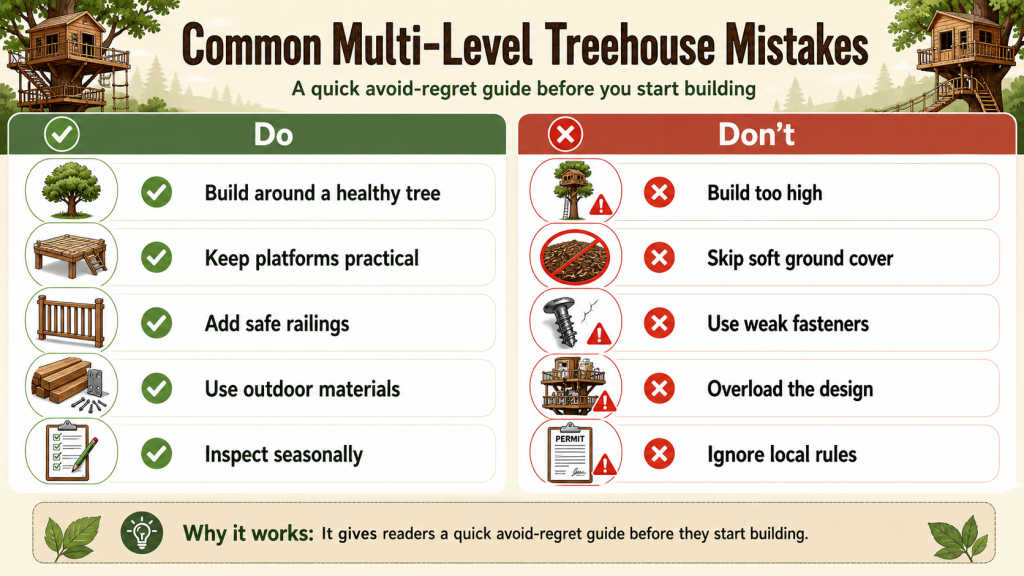
Common Mistakes To Avoid
Do not start with the highest platform first. Start with safety, access, and purpose.
Avoid these mistakes:
- Building too high
- Skipping soft surfacing
- Using indoor furniture outdoors
- Forgetting drainage
- Adding too many features
- Creating narrow traffic spots
- Ignoring local permits
- Attaching hardware without tree-friendly methods
The best treehouse feels simple, not overloaded. Give it breathing room.
Budget And Planning Tips
A DIY treehouse can cost a little or a lot, depending on size, height, materials, and whether you hire help.
Budget for:
- Lumber
- Hardware
- Fasteners
- Surfacing
- Railings
- Roofing
- Tools
- Accessories
- Professional inspection
If your design has multiple levels, bridges, or sleeping areas, talk to a builder. It may feel less romantic, but it beats guessing your way through structural loads.
Maintenance Keeps The Magic Alive
A treehouse is not a “build it and forget it” project.
Check it every season for:
- Loose bolts
- Splintered wood
- Rust
- Rot
- Wobbly railings
- Damaged rope
- Pest activity
- Branch growth near the structure
After storms, inspect it again. Trees move, wood shifts, and weather has no respect for your Pinterest board.
FAQs About Designing A Multi-Level Treehouse
How high should a Multi-Level Treehouse be?
Keep it as low as possible while still making it fun. For family builds, lower platforms are usually safer and easier to supervise. Higher levels should have strong railings, safe access, and soft surfacing below.
What is the best tree for a backyard treehouse?
Strong hardwood trees like oak, maple, and beech are common choices. The tree should be mature, healthy, and structurally sound. Always avoid dead, diseased, cracked, or unstable trees.
Can I build a multi-level treehouse without a tree?
Yes. You can build a treehouse-style elevated playhouse using posts instead of relying fully on a tree. This may be better for yards without suitable trees or for more controlled structural support.
What should I put under a treehouse for safety?
Use shock-absorbing material such as wood mulch, engineered wood fiber, sand, pea gravel, or rubber safety surfacing. Avoid concrete, asphalt, packed dirt, or thin grass under climbing zones.
Does building a treehouse require a permit?
Maybe. Permit rules depend on your city, size, height, electrical work, and whether the structure is considered temporary or permanent. Check local building rules before construction.
Conclusion
A Multi-Level Treehouse is one of those backyard projects that can become part of a family’s story. The best designs balance imagination with common sense. Start with a healthy tree, plan each level with a clear purpose, use safe access points, add strong railings, and choose materials that can handle weather and real play.
You do not need to build the biggest treehouse on the block. Build the one that fits your yard, your family, and your comfort level. Keep it safe, make it personal, and leave a little room for wonder. That is where the real magic climbs in.