How to Design a Treehouse Entrance That’s Both Safe and Magical
We may earn a commission for purchases made using our links. Please see our disclosure to learn more.
A great Treehouse Entrance should make the climb feel like an adventure, not an obstacle course. That sounds simple until you start choosing between stairs, ladders, trapdoors, gates, handholds, and decorative details. The right answer depends on who will use it, how high the platform sits, and how exposed the approach is to rain, mud, and darkness.
This guide covers access style, landings, grip, guarding, materials, and maintenance, then shows where you can add personality without making the route harder to use. You’ll also find selected accessories, research-backed safety context, and answers to common questions.
Start With the People Who Will Use the Treehouse Entrance
Design the route around the least confident regular user, not the boldest climber. Younger children, visiting grandparents, or anyone carrying blankets and snacks will appreciate a predictable approach.
Stairs are usually easiest when space allows. An angled or ship-style ladder saves room while giving feet a clearer target than a vertical ladder. Rope ladders and climbing walls demand more balance and often work better as secondary routes.
Choose an Access Style That Fits the Yard
Look at the ground before choosing a Treehouse Entrance. Stairs need room and stable support; a fixed ladder needs a clear climbing zone; a trapdoor needs enough platform space for someone to emerge without stepping into a railing or doorway.
Also consider traffic. A narrow route becomes awkward when someone climbs while another person comes down. From the ground, users should be able to see where to start and where the next foot- and handholds are.
Keep the Treehouse Entrance Height in Perspective
Height changes the consequence of a mistake. A dramatic climb can look exciting in a sketch, but a lower platform often gives you more freedom to make the entrance playful without making every slip more serious.
Tree health, structural design, local rules, and user ability all matter. For a high, complex, or tree-supported build, consider input from a qualified arborist or structural professional before construction.
Build a Stable Landing Before the Door or Hatch
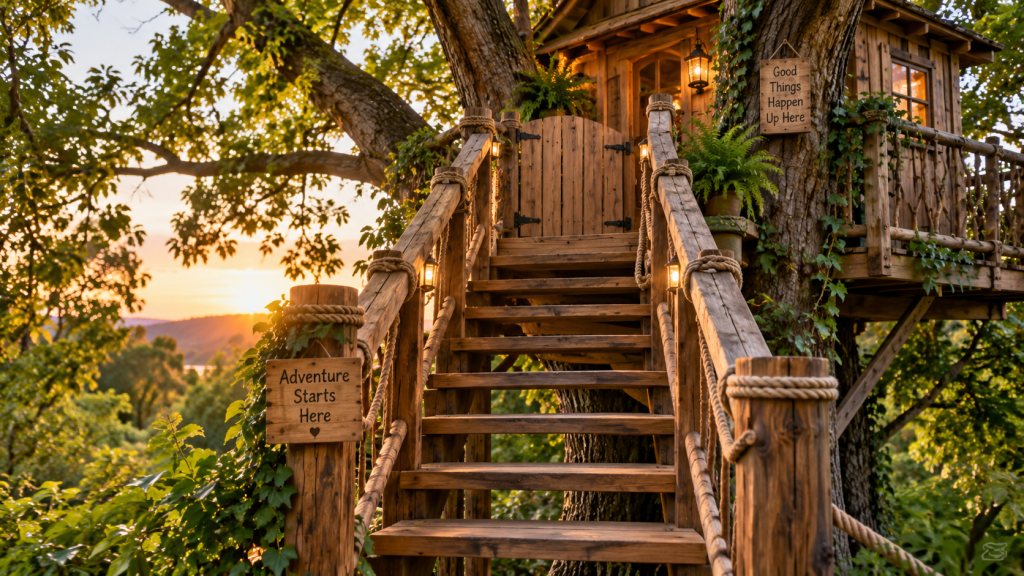
A stable landing lets climbers transition from climbing to standing before they open a gate or hatch. That matters because people often reach the top with one hand occupied or their body turned.
Keep the Treehouse Entrance landing clear of toys, protruding hardware, and trim that catches clothing. A hatch should not force an awkward stance, while a side door should open without requiring a backward lean over the access route.
Give Hands Something Solid to Hold
Reliable hand placement matters as much as footing. A climber should be able to keep a secure grip while moving from the access route onto the platform.
Put handholds where users naturally reach rather than where they merely look symmetrical. Avoid sharp edges, splinter-prone surfaces, and exposed hardware that becomes an accidental grip. On steep ladders, side rails or well-placed grips can make the top transition more controlled.
Before finishing, have intended users move through the route slowly under supervision and note awkward reaches.
Make Steps and Rungs Easy to See and Grip
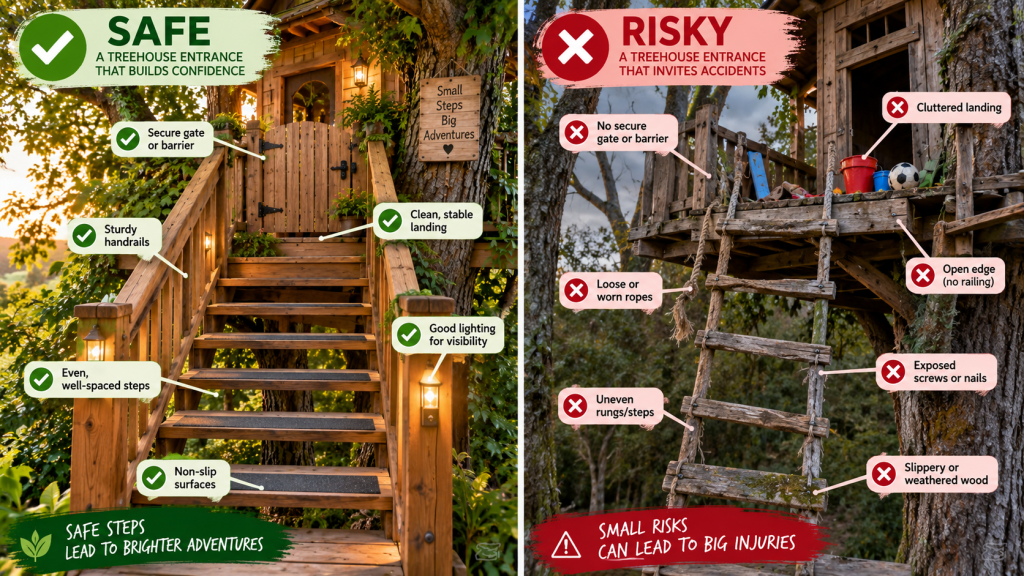
Consistency helps people climb without studying every foot placement. Keep rung or step spacing uniform, secure each piece against movement, and avoid slick finishes where rain or dew may collect.
Traction tape can add grip to suitable treads, but it cannot fix loose boards, poor drainage, or a badly proportioned Treehouse Entrance. For character, decorate around the steps instead of changing their geometry. Painted rails or small woodland motifs add personality while keeping footing predictable.
Protect the Opening With Guards, Gates, or Barriers
The top opening can become the weak point of an otherwise well-guarded platform. A gate may work when it is sturdy and easy to operate without creating a trapping hazard. With a hatch, consider hinges, pinch points, weight, and how it stays open.
Never rely on a decorative chain or flimsy latch as the main fall barrier. If your Treehouse Entrance meets an exposed deck or landing, compare treehouse railing ideas for safety and style before deciding how the guard, gateway, and view should work together.
Add Magic Without Creating New Hazards
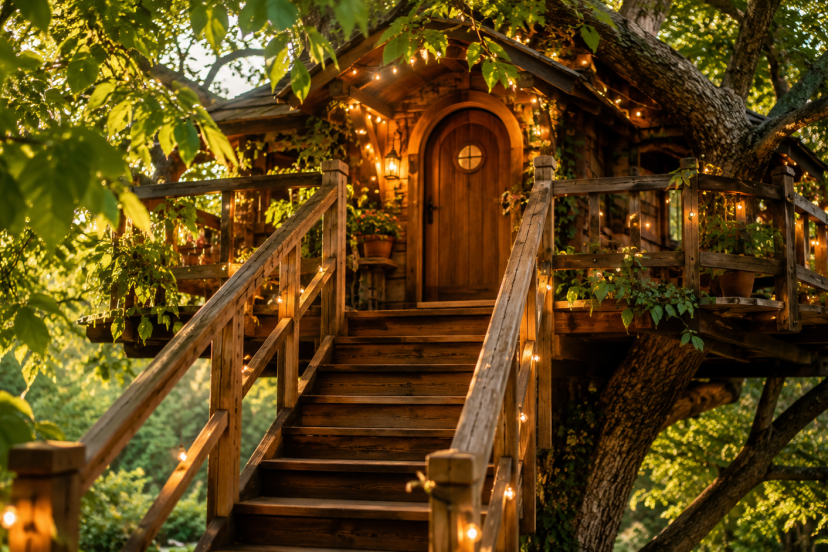
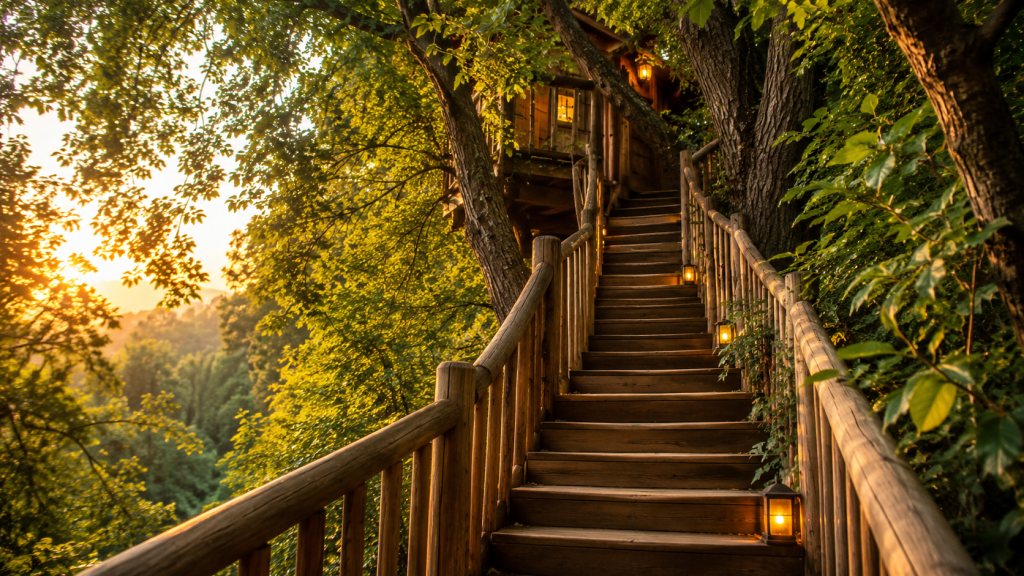
A Treehouse Entrance can feel like a castle gate, woodland portal, pirate gangway, or secret hatch without turning the climb into an obstacle course.
Try a painted sign, leaf-shaped trim, a small flag, contrasting door color, or child-height peephole. Keep ropes, bells, and hanging pieces away from the climbing path, and avoid loops that could create entanglement hazards.
Anything children are likely to grab should either be designed to take that load or placed where it will not tempt them during the climb.
Plan Lighting for Evening Climbing
A route that feels simple at noon can become confusing at dusk. Lighting near the first step, top landing, and doorway helps users see changes in level and locate handholds.
Solar step lights are convenient where panels receive enough sun; properly installed low-voltage lighting can provide more predictable output. Treat decorative lighting as supplemental to any illumination required locally.
For a calmer Treehouse Entrance, use small shielded fixtures that light the walking surface instead of shining into a climber’s face.
Choose Weather-Ready Materials and Hardware
The entrance receives constant wear from shoes, hands, dirt, rain, and repeated movement. Use exterior-suitable materials and corrosion-resistant fasteners appropriate for the wood and environment.
Watch end grain, water-trapping joints, and horizontal surfaces where moisture lingers. Pressure-treated lumber also needs compatible fasteners.
If the Treehouse Entrance connects to a living trunk, do not improvise attachment details. Trees grow and move, so tree-supported structures need hardware and connections chosen for loading, tree health, and long-term movement rather than convenience.
Recommended Products for a Safer Treehouse Entrance
These products address traction, controlled access, lighting, and secondary climbing. None replaces sound structural design, guarding, or local code review.
Lifegrip Anti Slip Traction Tape, 4 Inch x 38 Foot – Best Grip, Friction, Abrasive Adhesive for Stairs, Tread Step, Indoor, Outdoor (4″ X 38′)
Best for: Adding grip to smooth fixed steps or treads
This 4-inch-wide tape uses an 80-grit aluminum-oxide traction surface on a PET backing. It can add texture to suitable smooth treads without rebuilding the entrance. The limitation is straightforward: adhesive tape works best on clean, sound surfaces and cannot compensate for loose, rotten, uneven, or poorly drained steps.
National Hardware LokkLatch Keyed Gate Latch for Wood, Metal and Vinyl Fence
Best for: Adult-controlled access at a compatible entrance gate
This keyed latch offers horizontal and vertical adjustment and uses a polymer body with stainless-steel components. It can suit a properly framed gate where adults want controlled access. However, a keyed latch can complicate emergency exit, so it should never be configured in a way that could trap occupants inside the treehouse.
Squirrel Products 6 ft. Climbing Rope Ladder for Kids – DIY Swingset Addition for Outdoor Play Equipment
Best for: A playful secondary climbing route
This six-foot rope ladder uses wooden rungs, nylon rope, and metal hanging rings. It creates a classic treehouse feel without requiring a permanent staircase footprint. Because a flexible ladder sways and demands more balance than fixed access, it is better treated as an optional route for capable climbers than an automatic choice for every user.
SOLPEX Solar Deck Lights Outdoor 16 Pack,Step Light Waterproof,Warm White | Led Solar lights for Outdoor Stairs,Step,Fence,Yard,Patio and Pathway
Best for: Adding low-effort visibility around steps and landings
This 16-pack uses warm-white LEDs, integrated solar charging, and automatic dusk-to-dawn operation. The compact lights can mark step edges or the approach without new wiring. Solar performance depends on sun exposure and weather, though, so use them as supplemental lighting rather than the only illumination where dependable light is required.
32Pcs Rock Climbing Holds, Multi Size Climbing Wall Grips for Kids Adult | Playground DIY Rock Wall Holds, Weather Resistant Bouldering Rocks with Hardware, Ideal Holiday Birthday Gift for Boys Girls
Best for: An adventurous climbing-wall-style secondary entrance
This set includes 32 resin climbing holds in multiple sizes and shapes with mounting hardware. The variety lets you create different reaches instead of repeating one grip. Still, the holds are only one part of the system: wall framing, panel thickness, fasteners, the fall zone, and route design determine whether the finished setup is appropriate.
What Research Says About a Safer Treehouse Entrance
Treehouse-specific research is limited, but available evidence emphasizes fall prevention. A 2009 peer-reviewed study of U.S. pediatric treehouse injuries estimated 47,351 emergency-department-treated injuries among people age 19 and younger from 1990 through 2006. Falls accounted for 78.6% of cases, and fractures were the most common diagnosis at 36.6% (Randazzo et al., 2009).
For practical design, the CPSC Outdoor Home Playground Safety Handbook covers protective surfacing, ladder handholds, hardware, and inspection. The CPSC Public Playground Safety Handbook also addresses access, guards, and entrapment hazards, although playground guidance is not automatically a backyard-treehouse code.
As a residential reference, the 2024 International Residential Code guard provision requires guards on certain open-sided walking surfaces more than 30 inches above the floor or grade. Local adoption and treehouse classification vary, so verify the rules where you live.
Inspect the Entrance as the Tree and Structure Change
A Treehouse Entrance needs ongoing attention. Repeated climbing can loosen connections, weather can damage wood, and living trees can shift relative to the structure.
Check regularly and after severe storms for loose handrails, cracked rungs, protruding fasteners, corrosion, slippery growth, swollen gates, and new pinch points. Test latches and hatches from both sides.
If something suddenly binds or changes alignment, investigate the cause rather than forcing it back into position.
Treehouse Entrance FAQs
What is the safest type of Treehouse Entrance for younger children?
A conventional staircase with secure handrails is often easiest for younger children because footing is broad and predictable. An angled fixed ladder may also suit some families. The right choice still depends on platform height, supervision, guarding, and the child’s abilities. Flexible rope ladders and climbing routes usually demand more coordination and confidence.
Should a treehouse ladder be vertical or angled?
An angled ladder generally gives climbers a more stair-like body position and makes the next rung easier to see and reach. A vertical ladder saves ground space but requires more upper-body effort. Whichever you choose, secure it against movement and provide reliable hand placement through the transition onto the platform.
How wide should a Treehouse Entrance be?
There is no universal width for every treehouse. The opening should suit intended users, the access type, gate or hatch hardware, surrounding guards, and local requirements. Make it wide enough to pass through without twisting or catching clothing, while avoiding an unnecessarily large unprotected gap at the edge of an elevated platform.
Can a rope ladder be the main entrance?
It can, but it is not the most accessible choice for many families. A rope ladder moves under load and requires balance, grip strength, and confidence. Where children, less-mobile adults, or frequent visitors use the treehouse, a stable staircase or fixed ladder usually provides a more predictable primary route.
How can I make the entrance magical without making it harder to use?
Keep the climbing geometry simple, then add character around it. A painted door, small sign, themed trim, flag, gentle lighting, or hidden-message plaque can create a memorable arrival without changing rung spacing or hand placement. The safest decorative details sit beside the route, not where feet and hands need dependable contact.
Final Recommendation: Make the Treehouse Entrance Feel Like an Invitation
The best Treehouse Entrance combines an access style people can use confidently, a protected transition onto the platform, and details that make the climb feel special. Choose stairs or an angled fixed ladder when predictable access matters most; save rope ladders and climbing holds for users who can comfortably manage the extra movement.
Then focus on solid handholds, traction, lighting, weather-ready hardware, guarding, and regular inspection. Lifegrip traction tape or SOLPEX solar step lights can support those details, but neither substitutes for sound construction.
Build the simplest safe route that fits your users, verify local requirements, and add the storybook character around that dependable foundation.