How to Build a Tree House: A Practical Step-by-Step Guide
We may earn a commission for purchases made using our links. Please see our disclosure to learn more.
Learning how to build a tree house is less about nailing boards into branches and more about making good decisions before the first cut. The tree must be healthy, the structure needs a clear load path, the attachments must allow for growth and movement, and the finished platform needs safe access and fall protection.
This guide explains how to build a tree house from site selection through framing, weatherproofing, and maintenance. It also shows where local rules and professional advice matter, what tools can make the job easier, and which shortcuts tend to cause trouble later. Whether you want a children’s play space or a quiet backyard retreat, the goal is the same: a simple design that works with the tree instead of fighting it.
Start With the Site, Tree, and Purpose
Decide who will use the treehouse before choosing its size or height. A children’s platform needs different access and fall protection than an adult retreat.
Check the tree for cavities, cracks, dead limbs, fungal growth, or root damage. Species, soil, wind, and past pruning matter too. If the tree will carry structural load, have an arborist assess it. Also check power lines, boundaries, drainage, slopes, and hard surfaces below.
Check Local Rules Before You Buy Lumber
Requirements vary by location. The 2024 International Residential Code exempts some accessory structures and low decks, but local jurisdictions decide what they adopt and how they classify a treehouse.
Ask your building department about permits, setbacks, height, electrical work, guards, stairs, and neighborhood restrictions. This matters when learning how to build a tree house because revising a drawing is easier than rebuilding.
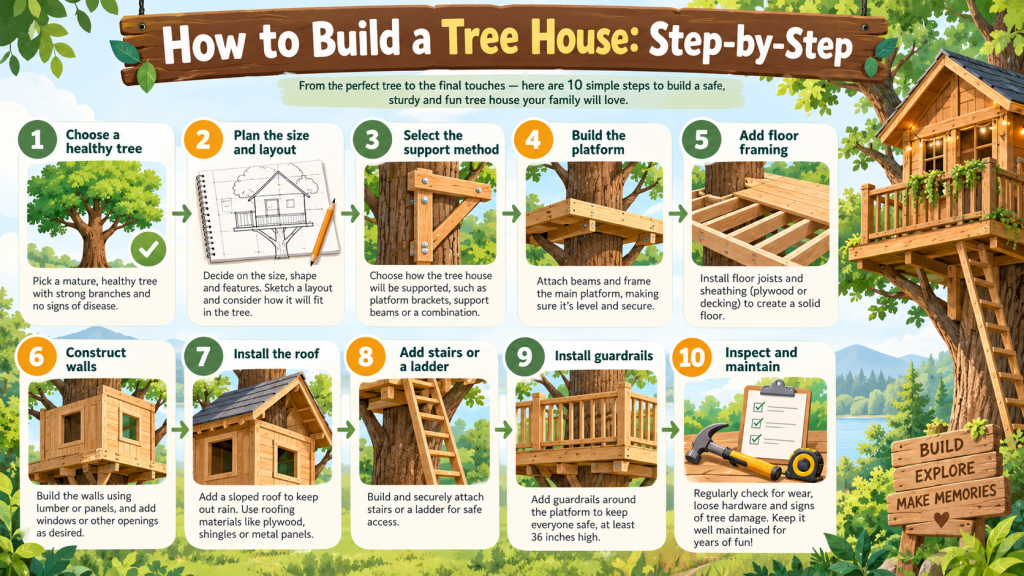
Choose a Treehouse Design That Matches the Support
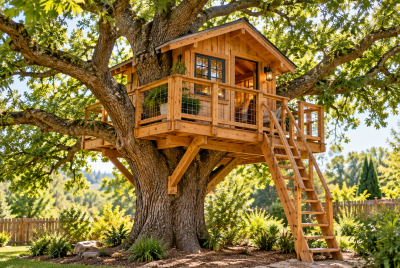
Let the site determine the design. A single trunk, two-tree span, tree-plus-post structure, and freestanding platform support weight differently.
Before settling on dimensions, compare these treehouse floor plans to see how layouts change the support strategy. Keep the load path easy to trace. For large, high, adult-occupied, or multi-tree projects, use site-specific guidance.
How to Build a Tree House Support System
The platform is the structural core. Beams, joists, braces, posts, connectors, and attachments must work as one system.
Follow the hardware manufacturer’s instructions or an engineered plan. Do not copy bolt sizes from a photograph; unnecessary holes wound the tree, while incorrect connections can undermine the load path. Multiple trees move independently, so rigid connections can cause problems. Get structural advice when the support strategy is uncertain.
Plan for Loads, Tree Growth, and Movement
A treehouse carries framing, people, furnishings, wind, rain, and sometimes snow. Use a design that addresses site loads instead of estimating capacity.
Leave clearance around trunks and branches so growth does not press against decking, walls, or roofing. Multi-tree designs may need movement-accommodating connections. Mark each attachment before drilling; more fasteners do not automatically mean more strength.
Gather Materials and Tools Before Framing
Use plan-specified structural lumber, decking, corrosion-resistant fasteners, connectors, roofing, and guard components. Exact sizes should come from the design.
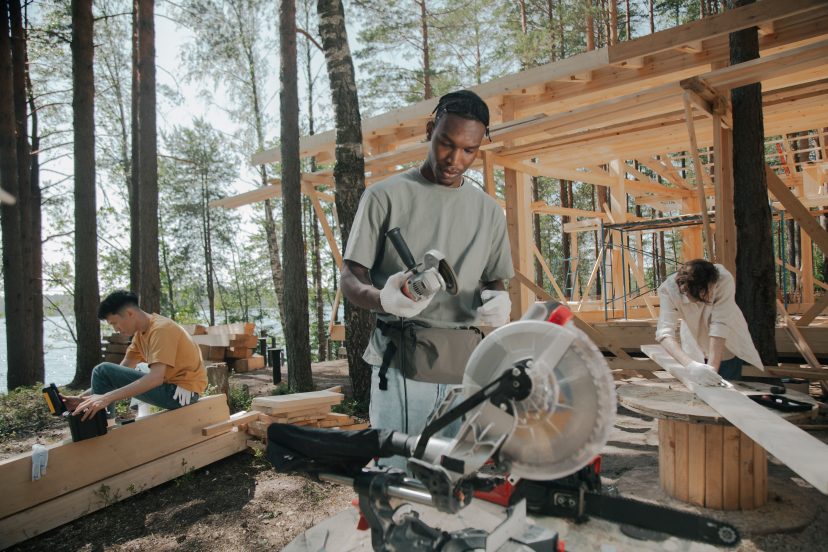
Common tools include a tape measure, level, drill/driver, circular saw, square, clamps, wrenches, and protective equipment. Cut on the ground when possible. When figuring out how to build a tree house efficiently, label parts and sort hardware so structural fasteners are not confused with ordinary screws.
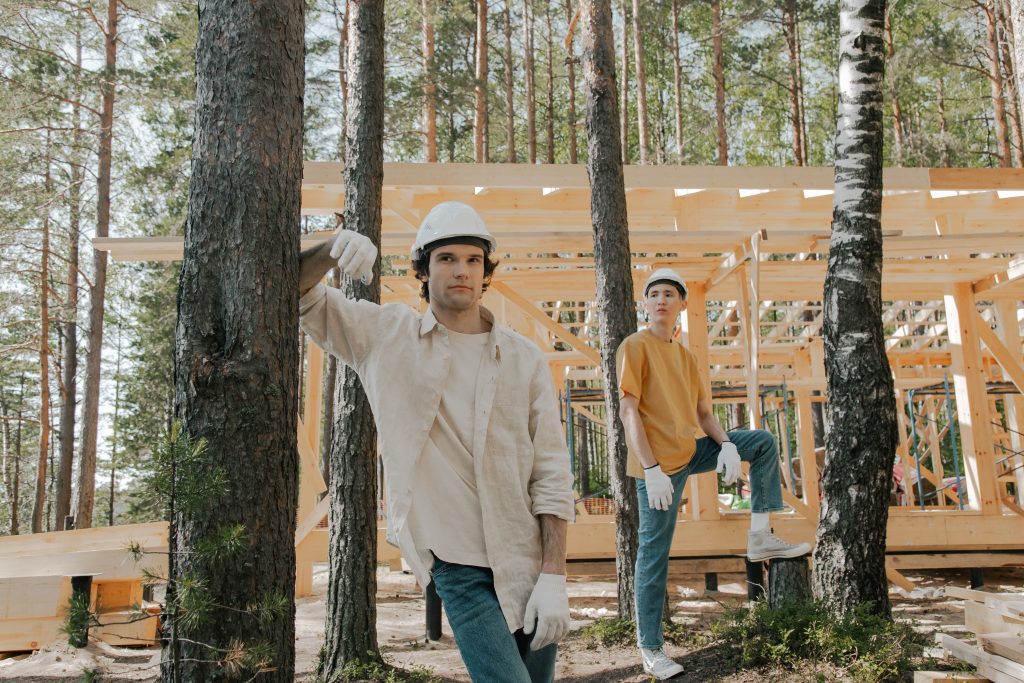
Build the Main Platform and Keep It Level
After installing the supports as designed, establish a level reference and frame from it. Compare diagonals to check square, then recheck level as joists and blocking go in.
Use the specified connectors and fasteners. Load-bearing posts need foundations suited to local conditions, not loose soil or improvised pavers. Before decking hides the frame, inspect every beam, brace, and attachment.
Frame the Floor, Walls, and Roof
Install decking with the recommended spacing so water drains, while preserving clearance around trunks. Removable trim can simplify growth adjustments.
Keep walls light and choose a roof that sheds water reliably. Tree penetrations should drain without tightly wrapping the trunk. For someone learning how to build a tree house, a simple shed or gable roof is easier to frame and maintain than intersecting rooflines.
Add Safe Access, Railings, and Openings
Plan access as carefully as the platform. Stairs need more space; ladders save room but require secure handholds and a safe deck transition.
Guard elevated edges according to local requirements and user age. Remove protruding fasteners, sharp edges, snag points, and pinch hazards. For children’s structures, be cautious with ropes, cords, swings, and climbing accessories because casual additions can create fall or entanglement hazards.
Weatherproof Without Trapping the Tree
Use exterior-rated materials suited to your climate and detail the roof, walls, and deck so water drains. Clear debris around branch openings.
Avoid tight flashing, cable, trim, or roofing around a living trunk. Keep bolts, brackets, drainage gaps, and roof edges accessible. Knowing how to build a tree house well includes making future inspections and growth adjustments straightforward.
Research-Backed Safety Lessons for Treehouse Builders
No single study explains how to build a tree house safely for every design, so useful evidence comes from safety guidance, codes, and arboriculture.
The U.S. Consumer Product Safety Commission’s home-playground guidance, published in 2007, cites a 2001 study of 1999 emergency-room cases: nearly 47,000 home-playground injuries were reported, and 81% involved falls. The data are old and not treehouse-specific, but they reinforce guarded edges, predictable access, protective surfacing, and entrapment prevention.
The International Society of Arboriculture’s construction guidance identifies trunk injury, root compaction, severed roots, and drainage changes as common construction damage, recommending arborist involvement when construction may affect a tree.
The 2024 International Residential Code provisions show why local verification matters: categories, exemptions, and adopted rules vary by jurisdiction.
Recommended Products for How to Build a Tree House
These six picks cover planning, layout, drilling, cutting, clamping, and hearing protection without repeating the same tool.
| Product | Best for | Standout feature | Main consideration |
| Black & Decker Complete Photo Guide to Treehouses, 3rd Edition | First-time planners | 224-page visual guide | Plans need site adaptation |
| DEWALT DCD771C2 Drill/Driver Kit | Drilling and fastening | Two speeds; two batteries | Follow the structural plan |
| DEWALT DCS391B Circular Saw | Cordless framing cuts | 6-1/2-inch blade; 5,150 RPM | Battery not included |
| Swanson S0101 7-Inch Speed Square | Layout | Five functions | Compact size |
| IRWIN 1964758 Mini Bar Clamps | Solo alignment | Four one-handed clamps | 6-inch capacity |
| 3M WorkTunes Connect | Hearing protection | 26 dB NRR; Bluetooth | Proper fit required |
Black & Decker The Complete Photo Guide to Treehouses 3rd Edition: Design and Build Your Dream Treehouse
Best for: First-time planners who want visual guidance
This 224-page guide covers tree selection, safety, support systems, platforms, walls, roofs, access, and complete project plans. Step-by-step photography helps make unfamiliar stages easier to visualize. Published plans still need adapting to the actual tree, site, loads, and local rules.
DEWALT 20V Max XR Drill Driver, Battery and Charger (DCD771C2)
Best for: Builders who need a versatile cordless drill/driver
The DCD771C2 has a two-speed transmission and 1/2-inch ratcheting chuck, while the kit includes two batteries, a charger, and bag. It suits repeated drilling and fastening without a trailing cord. Match the bits, torque, and fasteners to the structural plan instead of letting the tool determine the connection.
DEWALT 20V MAX Circular Saw, Cordless Sidewinder Style Portable, 6-1/2-Inch Blade, 5150 RPM, 0-50 Degree Bevel Capability, Battery Not Included (DCS391B)
Best for: Cordless cutting of common framing lumber
This cordless saw uses a 6-1/2-inch carbide-tipped blade, runs at 5,150 RPM, and offers a 0–50-degree bevel range. Those features suit repetitive framing and decking cuts. It is a bare tool, so it makes most sense for someone who already owns compatible batteries and a charger.
SWANSON Tool Co S0101 7 Inch Speed Square, Blue
Best for: Budget-friendly layout and saw guidance
The S0101 is a 7-inch heavy-gauge die-cast aluminum square that works as a try square, miter square, saw guide, line scriber, and protractor. It is useful for marking square cuts and basic framing layouts without carrying several tools, though larger layouts may still call for a longer square or level.
IRWIN Quick-Grip 1964758 One-Handed Mini Bar Clamp 4 Pack, 6″, Blue
Best for: Solo builders holding small parts in position
This four-pack uses one-handed triggers, non-marring pads, reinforced resin bodies, and hardened steel bars. The clamps can hold trim, templates, or smaller pieces while you mark or fasten them. Their 6-inch capacity makes them useful helpers, but they are not substitutes for clamps sized for beams or wide assemblies.
3M WorkTunes Connect Wireless Hearing Protector with Bluetooth | Bluetooth Technology Hearing Protection with a 26 dB Noise Reduction Rating
Best for: Power-tool users who want hearing protection with wireless audio
This WorkTunes model combines Bluetooth audio with a 26 dB Noise Reduction Rating. It fits sawing or drilling sessions where hearing protection is needed and wireless audio is useful. As with any earmuff, protection depends on proper fit and use, so follow the manufacturer’s instructions and evaluate the actual noise exposure.
Common Mistakes That Make Treehouses Harder to Maintain
Tight decking around a trunk can become a pinch point as the tree grows, and extra holes do not replace a designed connection.
Keep bolts, brackets, roof edges, and drainage paths inspectable. Check the tree and structure regularly and after major storms for loose hardware, damaged branches, decay, blocked drainage, or changing clearances. When learning how to build a tree house, plan for maintenance from the beginning.
Frequently Asked Questions About How to Build a Tree House
What is the first step in how to build a tree house?
Define who will use it and what the structure must do, then evaluate the site and tree before designing the platform. If a living tree will carry meaningful load, consider an arborist assessment. Choose the structural layout only after you understand the tree, ground conditions, local rules, and intended users.
Is it possible to build a treehouse without drilling into the tree?
Yes. A freestanding structure on posts can sit among or beside trees without using a trunk as structural support. Hybrid designs can shift some load to independent posts. Posts still need suitable foundations, framing, guards, and code compliance, so “no tree bolts” does not mean “no structural planning.”
How high should a backyard treehouse be?
There is no universal safe height. Lower platforms generally reduce fall exposure and are easier to access, build, inspect, and maintain. The right height depends on the users, tree, terrain, design, and local requirements. For a child-focused build, avoid adding height simply for excitement when a lower platform can feel just as adventurous.
What wood should I use for a treehouse?
Use exterior-rated structural lumber or another material specified by the design and suitable for local exposure. Outdoor framing needs compatible corrosion-resistant fasteners and connectors. Do not assume every outdoor board suits a load-bearing beam or joist; follow the structural plan and material manufacturer’s instructions.
Do I need an arborist or engineer to learn how to build a tree house?
Not every small freestanding platform needs the same professional input. An arborist can evaluate tree health and construction impacts, while a structural professional can address loads, connections, movement, and unusual geometry. Professional advice is especially valuable for high, large, adult-occupied, multi-tree, or heavily customized structures.
Final Recommendation: How to Build a Tree House That Lasts
The best approach to how to build a tree house is to make the invisible decisions first: choose a suitable site and healthy tree, confirm local requirements, use a clear structural plan, and select attachments for the actual support system. Then build a level platform, manage water, protect elevated edges, allow room for growth, and keep key connections accessible.
For a first project, the Black & Decker photo guide can make the sequence easier to visualize, while the DEWALT DCD771C2 covers many routine drilling and fastening tasks. Neither replaces site-specific structural judgment. Keep the design modest, bring in an arborist or structural professional when conditions are uncertain, and plan for inspection from day one.