Kids Jungle Gym Buying Guide: 5 Playsets Worth Considering
We may earn a commission for purchases made using our links. Please see our disclosure to learn more.
A climbing frame looks exciting in a product photo, but will it actually fit your yard and suit your child’s abilities? A large wooden clubhouse also needs enough room for proper installation and maintenance. Choosing a kids jungle gym involves more than picking the structure with the most slides or bars. The playset needs enough room around it, appropriate climbing challenges, and a surface that helps reduce injuries from falls.
This guide compares common designs, explains the safety details worth checking before purchase, and highlights five distinct playsets to help you choose without paying for features your children may never use.
Decide What Kind of Jungle Gym You Actually Need
Start with the activities your children already enjoy. Climbing domes offer several routes up and across, while toddler activity centers combine short steps, tunnels, and slides. Full backyard playsets may add swings, monkey bars, and a clubhouse.
A bigger structure isn’t automatically better. If your child primarily likes sliding and pretend play, a compact climber might receive more attention than an elaborate overhead-bar system. For children who enjoy climbing at different angles, a dome makes better use of its framework.
Match the Climbing Challenge to Your Child’s Age
The manufacturer’s recommended age range is a starting point, not permission to skip supervision. Toddlers generally need reachable handholds, short climbs, and simple ways back down. Older children may want more complex routes or overhead bars once their grip and coordination are ready.
Check the maximum weight per child and total number of users separately. A structure rated for several children can still have individual platform limits.
Measure the Yard Beyond the Equipment Footprint
Measure the assembled width and length, then account for the surrounding fall zone. The U.S. Consumer Product Safety Commission recommends protective surfacing extending at least six feet beyond most home playground equipment in every direction. Swing areas often require additional clearance.
That means a ten-foot-wide dome generally needs roughly twenty-two feet of protected width when applying that guidance. Check the manufacturer’s instructions for the exact layout.
Compare Plastic, Metal, and Wooden Structures
Molded plastic climbers have rounded forms and surfaces that are generally straightforward to clean. Many suit younger children, although individual age and load limits vary. Steel climbing domes provide multiple handholds in an open frame; their coating should be checked for chips or corrosion.
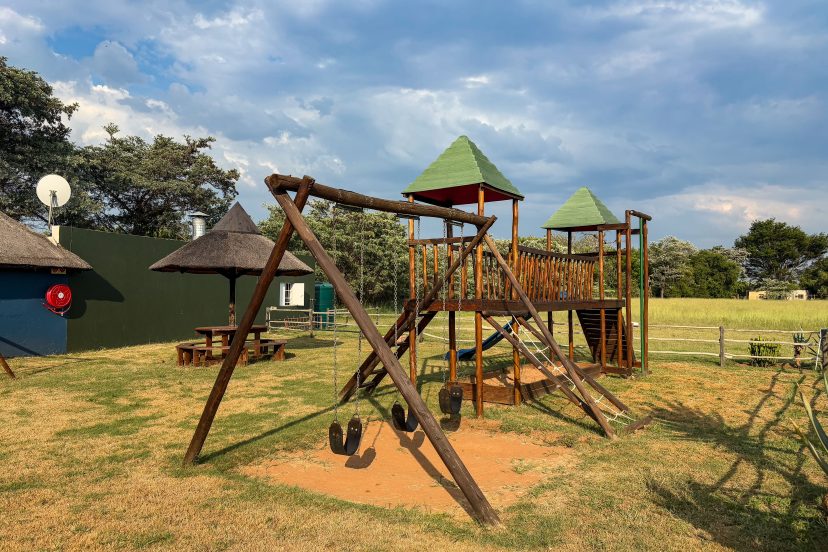
Wooden sets create a traditional treehouse appearance and can support larger combinations of play features. However, they require inspections for splinters, rot, loose hardware, and finish deterioration.
Prioritize Features Children Will Keep Using
A slide gives younger climbers an easy, predictable way to descend. Tunnels and steering wheels encourage imaginative games without requiring a tall structure. Climbing grips and bars create more route choices for children ready for them.
Check whether children can enter and leave without crossing directly into the path of a moving swing. Examine platform access, railings, exposed connectors, and places where clothing could catch. A few well-spaced activities are better than crowded features that interfere with one another.
Choose Between a Climbing Dome and a Combination Playset
A freestanding dome is a strong choice for climbing-focused play. Its curved framework provides different routes, and its open design makes supervision easier. The compromise is that it usually has no dedicated slide or sheltered clubhouse.
Combination sets offer more variety for siblings with different interests, but take longer to assemble and need a larger play area. Swing movement creates additional clearance requirements. If you are starting from nothing, a combined climber can be more versatile.
Budget for the Protective Surface, Not Just the Gym
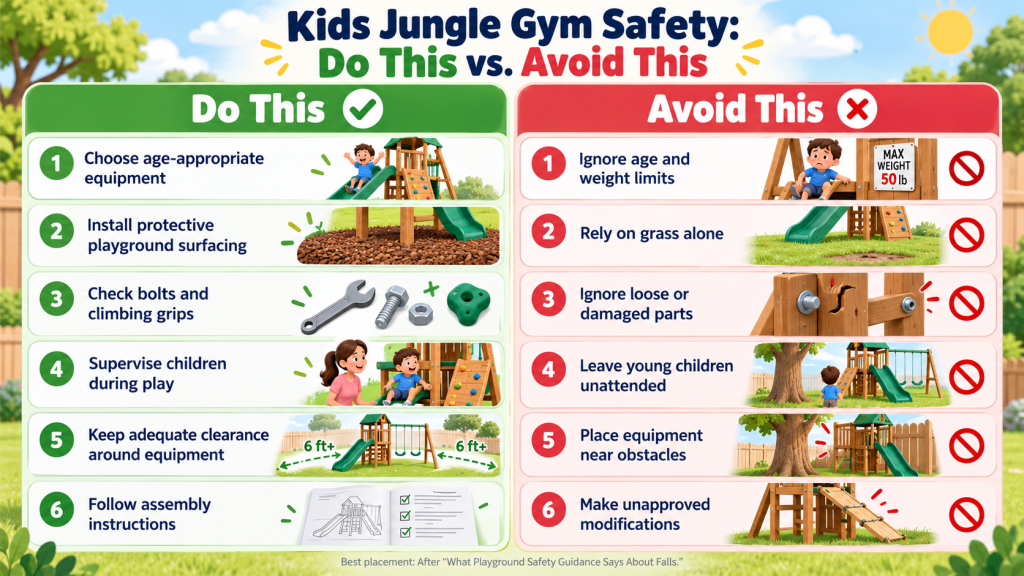
Grass and packed soil may appear soft but do not provide dependable fall protection. Use playground surfacing suited to the equipment’s fall height and the manufacturer’s installation instructions. Loose-fill materials need adequate depth and regular replenishment because they scatter and compress.
Safety-tested rubber mats or tiles can be another option when rated for the relevant fall height. Ordinary household foam tiles, carpeting, and thin exercise mats are not substitutes for certified impact-attenuating surfaces. This is a safety expense, not an optional decorative finish.
Position the Gym Carefully Near a Treehouse
If you’re creating a larger backyard adventure area, separate ground-level climbing from elevated treehouse access. A jungle gym should not become an improvised stepping stone onto a deck, roof, fence, or branch. Keep the required use zones clear and follow each structure’s installation guidance.
Place the playset where an adult can see the climbing routes, but away from driveways and water hazards. For a more detailed look at overhead climbing choices, see this guide to children’s monkey bars.
Check Assembly and Anchoring Requirements First
Look at the instruction manual before ordering. Confirm how many adults are recommended, what tools are needed, and whether the structure requires ground anchors or a foundation. Never assume all freestanding models can be placed on any surface without anchoring.
Make sure parts fit together as intended, and tighten hardware to the manufacturer’s instructions. Level the site before installation instead of trying to correct a wobbly frame afterward. Complex wooden sets may justify professional installation.
Plan for Cleaning, Inspections, and Repairs
Inspect the playset frequently, particularly after severe weather or heavy use. Look for loose bolts, damaged grips, cracked plastic, rust, deteriorating wood, unstable anchors, and worn suspension components. Follow the manufacturer’s inspection schedule and replace damaged parts with approved replacements.
Rake and replenish loose-fill surfacing as needed, particularly beneath the most-used climbing routes and slide exits. If a part becomes unsafe, close the structure to play until it is repaired. A routine inspection is cheaper than ignoring a small failure that worsens.
Avoid These Common Buying Mistakes
Don’t buy solely by advertised capacity, colorful photos, or the promise that a playset will last for years. Confirm the age range, user limits, available fall zone, and site preparation costs. An enormous set squeezed into a narrow yard is a poor fit, regardless of its features.
Also check replacement-part support, delivery access, and whether accessories are included or sold separately. Read the actual manual rather than relying on an abbreviated listing description. Avoid unapproved modifications such as tying ropes or adding swings to a structure not designed for them.
Recommended Kids Jungle Gym Products for Different Backyards
The following models suit different ages and types of play. Their layouts are not interchangeable; use each product’s current manual to confirm requirements before buying.
Little Tikes Hide and Seek Climber
Best for: Toddlers who enjoy climbing, sliding, and imaginative play.
The Little Tikes Hide and Seek Climber features a short slide, easy climbing steps, and a crawl-through area for playful adventures. Its compact plastic design suits younger children and smaller backyard spaces. The low climbing platform makes it approachable for beginners, although older children may quickly outgrow its simple activities.
Simplay3 Young Explorers Adventure Climber and Slide – Indoor Outdoor Backyard Playset for Toddlers and Kids
Best for: Preschoolers who like tunnels, climbing, and imaginative games.
The Young Explorers design includes a two-level platform, a wide slide, and a crawl-through hideaway with a steering wheel. Its double-wall plastic construction is intended for indoor or outdoor use, and it can connect with compatible Simplay3 modular playsets. Taller children may find the crawl space tight.
Eezy Peezy Climber with Top – Active Indoor Outdoor Play Set Climbing Dome Equipment Toys – Fun for Kids Ages 3 to 6 Years Old, Green and Blue
Best for: Younger children ready to try an open climbing frame.
This plastic climbing tower uses a connected framework with a top section for movement in different directions. The lightweight, indoor-outdoor design may appeal to families who want something less permanent than a large steel structure. It still needs appropriate fall protection and the stated assembly procedure. It’s less challenging for older children.
Lifetime Geometric Dome Climber Play Center – Climbing Dome Jungle Gym
Best for: Climbing-focused children with a roomy backyard.
Lifetime’s geometric dome uses powder-coated steel bars and molded climbing grips to create numerous routes across its frame. The model is approximately ten feet wide and five feet high, so allow substantial space for protective surfacing beyond its base. It has no built-in slide or clubhouse.
Backyard Discovery Montpelier Cedar Wood Swing Set, Wave Slide, Clubhouse, Monkey Bars, Picnic Area, Snack Bar, Belt Swings, Trapeze, Balcony, Playhouse, Working Door, Ladder, Outdoor Playset
Best for: Families wanting a full-size treehouse-style playground.
The Montpelier combines a cedar clubhouse, monkey bars, swings, trapeze, slide, and picnic area in one large residential set. The clubhouse creates a distinct play destination. Expect a major assembly project, ongoing wood maintenance, and considerably more clearance than a standalone climber requires.
What Playground Safety Guidance Says About Falls
Safety authorities place particular emphasis on the ground beneath playground equipment. The CPSC Outdoor Home Playground Safety Handbook recommends protective surfacing around residential equipment, typically extending at least six feet beyond its edges, with extra room for swings. It also advises checking anchors, hardware, entrapment openings, and supervision.
The American Academy of Pediatrics’ home playground guidance recommends choosing equipment labeled as meeting ASTM F1148 and using impact-absorbing surfacing. ASTM F1148 is a voluntary home-playground equipment standard, not proof that a product eliminates injury risk. These guidelines are not comparative tests of the playsets above. They help you compare models responsibly.
Frequently Asked Questions About Kids Jungle Gyms
What age is best for a kids jungle gym?
There is no universal starting age because designs vary considerably. Some low climbers are intended for toddlers, while taller domes and overhead monkey bars target older children. Follow the manufacturer’s minimum age, individual weight limits, and skill guidance. Choose a structure the child can navigate independently, with supervision.
Can a jungle gym sit directly on grass?
Grass alone is not adequate fall protection for elevated playground equipment. It does not consistently absorb impact. Install approved playground surfacing that matches the fall height, and extend it through the required use zone. Follow both the equipment manual and surfacing manufacturer’s instructions for installation depth and maintenance.
Is a metal or plastic climbing dome better?
Neither material is universally better. Plastic climbers can be lightweight and appropriate for simpler activities, while steel domes often offer larger climbing frameworks. Compare the specific products’ age ranges, load limits, finish quality, and assembly requirements. Both need inspections and protective surfacing.
How much space should I leave around the equipment?
For most home play equipment, plan for protective surfacing at least six feet beyond the structure in every direction, following CPSC guidance. Swings need additional space in the direction of travel, and the product manual may specify more. Measure the full play zone rather than the frame alone, and keep fences, buildings, trees, and other obstacles outside it.
Can I attach a jungle gym to an existing treehouse?
Only if the equipment manufacturer and a qualified designer explicitly approve that configuration. Separate structures may move differently, transfer unexpected loads, or create new fall and entrapment hazards. A standalone jungle gym near a treehouse is usually easier to evaluate. Keep the use zones separate, and never improvise an elevated bridge or climbing connection using unmatched components.
Conclusion: Choose the Right Playset for Your Family
The best kids jungle gym is the one that fits your child’s current abilities and the space you can prepare properly. Prioritize age limits, clear climbing routes, protective surfacing, and realistic maintenance before choosing extra features. A lower Step2 Lookout Treehouse makes sense for early sliding and pretend play, while the Lifetime Geometric Dome better suits children who want a dedicated climbing challenge.
Families with a spacious yard and several active children may prefer the Backyard Discovery Montpelier, provided they can accommodate its installation and ongoing upkeep. Measure the play zone before purchasing. Choose the right challenge and buy only the structure you can install and supervise responsibly.