Treehouse Railings That Keep Kids Safe
We may earn a commission for purchases made using our links. Please see our disclosure to learn more.
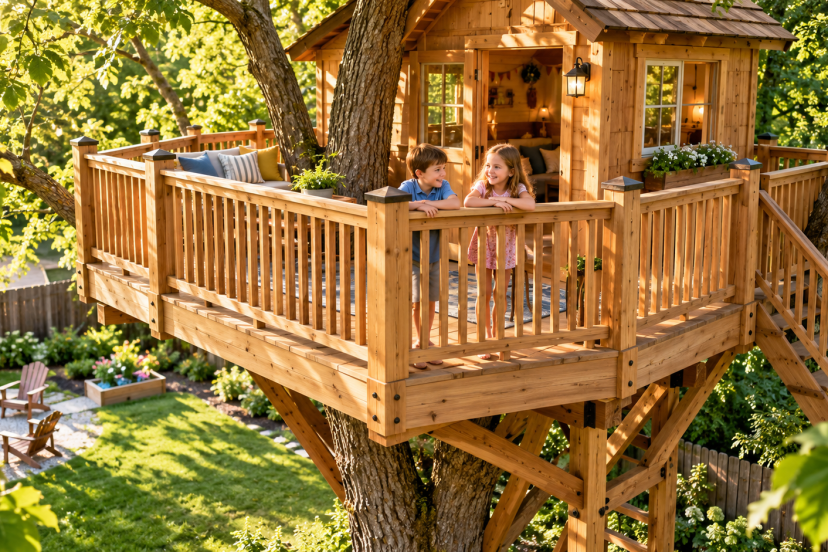
A treehouse can have a sturdy floor and a beautiful view, yet still be unsafe if a child can climb over—or slip through—the railing. Treehouse Railings deserve as much planning as the platform itself, especially when younger children will be playing several feet above the ground.
The challenge is choosing a barrier that prevents falls without putting too much strain on the structure or interfering with the tree. Height, opening size, post attachments, and access gates all matter. So does the difference between a decorative deck rail and a protective wall designed for active children.
This guide explains safer design choices, practical installation checks, and useful railing components. It also covers where professional advice is essential, because an attractive railing is only protective when the entire structure can support it.
Why Children Need More Than a Decorative Rail
A decorative rail marks the edge of a platform; a protective barrier must help stop children from falling through or climbing over it.
A wide-open farmhouse-style railing might suit an adult balcony but leave dangerous gaps in a playhouse. Children also move furniture and use benches as steps, so keep climbable objects away from perimeter walls.
Choose a Protective Barrier, Not Just an Open Guardrail
For a children’s treehouse, a solid or closely enclosed perimeter is generally preferable to widely spaced rails.
Vertical balusters can work as part of a properly engineered system, provided the openings are suitably small and the assembly resists expected loads. Avoid treating rope, decorative netting, or a single horizontal handrail as the main fall barrier. Rope and open handrails also create hazards.
Set the Height for the Users and the Fall
Railing height depends on the platform, the children using it, and applicable local requirements. For a child-focused treehouse, Nationwide Children’s Hospital recommends solid barrier walls at least 38 inches high.
Measure vertically from the finished deck surface, including any permanent flooring. If a bench or storage box effectively raises the standing surface, the barrier becomes easier to climb. Have the complete design checked against local rules rather than assuming one published measurement guarantees compliance.
Keep Openings Too Small to Slip Through
Small gaps are just as important as overall height. The U.S. Consumer Product Safety Commission’s guidance for protective playground barriers calls for openings smaller than 3½ inches. This applies to spaces between balusters, under bottom rails, and beside posts.
Measure the actual clear gap, not the distance between the centers of two pickets. Check triangular openings beside stairs and uneven spaces near the trunk as well. Recheck gaps as materials weather.
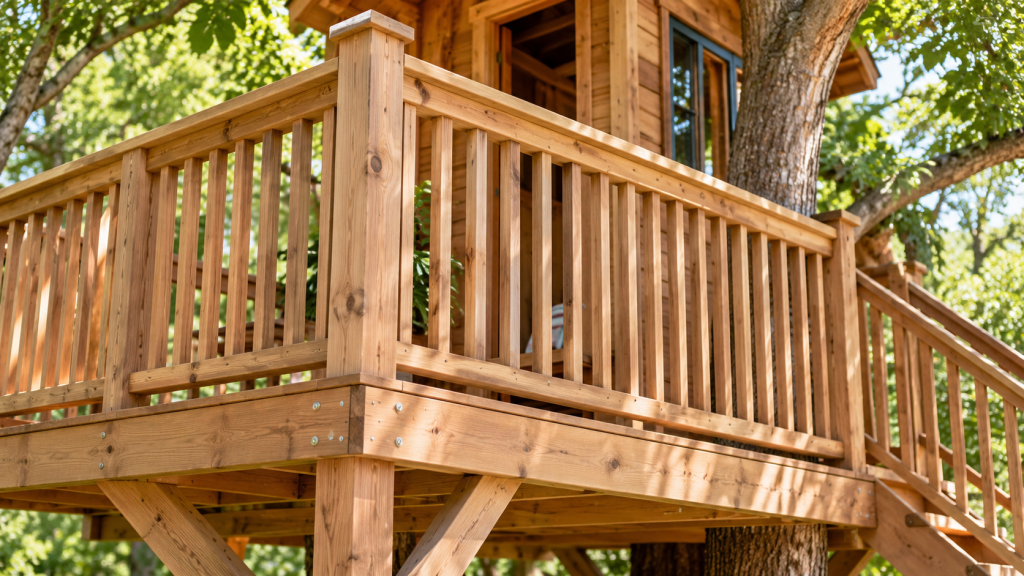
Compare Vertical Balusters, Panels, and Mesh
Choose based on child age and structural support.
| Design | Main advantage | Main consideration |
| Solid wood panels | Block large openings and climbing footholds | Add weight and catch wind |
| Vertical balusters | Allow airflow and visibility | Require precise spacing and secure fixing |
| Framed metal mesh | Preserve an open view | Must be rigid, properly framed, and difficult to climb |
| Horizontal cable or slats | Contemporary appearance | Can create footholds or problematic gaps |
Transparent panels are another possibility, but only when the panel material, framing, and attachments are designed and rated for guarding—not simply glazing or decorative screening.
Select Weather-Ready Wood, Metal, and Fasteners
Outdoor railings face moisture, sunlight, and repeated temperature changes. Use timber appropriate for exterior exposure, and protect cut ends as directed by the treatment or coating manufacturer. Check that metal parts and screws suit the wood species and environment.
Mixing incompatible fasteners and treated lumber can accelerate corrosion. Prioritize a durable complete assembly rather than choosing parts by appearance alone.
Anchor Posts to the Structure, Not Deck Boards
A railing post must transfer someone leaning against it into the structural framing below. Attaching it only to surface deck boards—or using ordinary trim screws—is not adequate.
Manufacturer instructions for structural connectors, such as Simpson Strong-Tie’s DTT2Z installation guidance, illustrate why specified fasteners and framing details matter. Those deck details are not automatically valid for a moving, tree-supported platform. Ask a qualified builder or engineer to design the post connections before purchasing decorative components.
Measure and Lay Out Each Railing Run
Start with the completed platform dimensions, not the original sketch. Identify every corner, stair opening, gate, trunk penetration, and expected post location. Then check that the chosen railing kit fits the actual space without exceeding its permitted span.
Account for the thickness of posts and brackets before cutting rails. Measure clear gaps at both ends; never patch a short run with loose filler. Confirm that gates can swing without striking branches or the landing.
Make Stairs, Ladders, and Gates Part of the Guard
The entrance is often the weakest part of an otherwise enclosed platform. A properly designed gate should latch reliably, resist pushing, and avoid creating a new foothold near the top of a ladder.
Built-in steps with appropriate handholds are generally more manageable for younger users than swinging rope ladders. Keep access openings closed when children are playing; teach them to enter and exit one at a time.
Allow for Tree Growth and Movement
A railing fastened rigidly between independently moving supports can twist or loosen as the tree moves.
Never trap a trunk against rigid railing components. The gap itself still needs a professionally designed protective solution. For complex tree-supported structures, consult an arborist about tree health and a structural professional about movement allowances and independent support.
Inspect Railings and Protect the Ground Below
Inspect before each play season and after severe weather. Check for wobbling posts, loose connectors, sharp edges, splinters, corrosion, cracked panels, and gates that no longer latch. Stop using the treehouse until any structural defect is repaired.
Before replacing an existing guard, review the platform and access points using these treehouse safety tips.
Nationwide Children’s advises at least 9 inches of suitable loose-fill surfacing extending 6 feet around the structure; maintain its depth and keep the landing zone free from exposed roots, stones, and furniture. Surfacing reduces impact hazards but cannot replace an effective barrier.
Recommended Products for Treehouse Railings
These components address different parts of a railing project. None should be considered a complete, child-safe solution without an appropriate structural design.
Deckorators Aluminum Classic 6 ft. x 36 in. Textured Black Line Rail Kit
Best for: A coordinated metal railing run on a compatible, structurally supported platform.
This aluminum line-rail kit combines matching rails and vertical balusters in a six-foot section, giving builders a consistent appearance without fabricating every piece. At 36 inches high, it falls short of the 38-inch solid-barrier guidance for children, so it cannot serve as the sole treehouse guard. Posts, connections, clear openings, and suitability for a children’s treehouse still need separate verification; a kit’s appearance does not establish fall protection.
ZONEGRACE 105-Pack 26-Inch Aluminum Deck Balusters with Screws and Connectors
Best for: Filling multiple runs of an existing, correctly engineered wooden rail frame.
This pack includes 26-inch round black aluminum balusters with connectors and screws for wooden railing projects. It can help achieve a uniform vertical-picket layout across longer sections. However, the balusters are infill pieces, not structural posts or a finished barrier. Check the rail dimensions, actual clear spacing, and fastener suitability before using them around children.
Goovilla 20-Piece 2×4 Deck Railing Bracket Connectors, Black
Best for: Connecting appropriately sized wood rails to compatible posts.
These black nylon brackets are intended for 2×4 wooden rail connections and come with installation screws. They can simplify alignment where a timber frame has already been designed for the required loads. Their role is limited to rail-to-post connections: they do not reinforce weak posts, replace engineered structural fasteners, or prove that a treehouse guard meets child-safety guidance.
D&D ML3TPKA MagnaLatch Top Pull 20-Inch Pool Safety Gate Latch, Black
Best for: A compatible square-frame access gate requiring a raised pull latch.
The MagnaLatch Top Pull is a gate-latching option designed for appropriate safety-gate installations, with the release positioned high on the assembly. That layout may help restrict casual access when the gate geometry matches the manufacturer’s instructions. It is not a substitute for supervision, proper gate height, or a fully enclosed perimeter, and compatibility must be checked before installation.
D&D TCHD1L2S3BTS TruClose Heavy Duty Self-Closing Gate Hinges, Black, 2-Pack
Best for: A suitably framed treehouse access gate that should close automatically.
This pair of TruClose heavy-duty hinges is designed to self-close compatible square-post gates made from wood, metal, or vinyl. The adjustable mechanism can help a properly fitted entrance return to the closed position. It still needs a matching latch, correct mounting, and regular alignment checks; the hinges cannot make a poorly supported gate safe.
What Safety Guidance Says About Falls and Barriers
The CPSC’s Outdoor Home Playground Safety Handbook distinguishes ordinary guardrails from protective barriers. It recommends guarding home-playground platforms above 30 inches, with minimum barrier heights varying by elevation; for higher platforms, protective barriers should have openings under 3½ inches and no climbable crossbars.
For treehouses specifically, Nationwide Children’s Hospital’s 2025 safety guidance recommends solid walls at least 38 inches high, lower platform placement, safe access, and impact-absorbing surfacing. Its injury-prevention guidance reflects the danger of falls from elevated play areas, not a claim that any railing eliminates risk.
These sources serve different purposes: playground recommendations and pediatric treehouse advice are not interchangeable building codes. Have local requirements and the actual structure reviewed by a professional, particularly for elevated or tree-supported platforms.
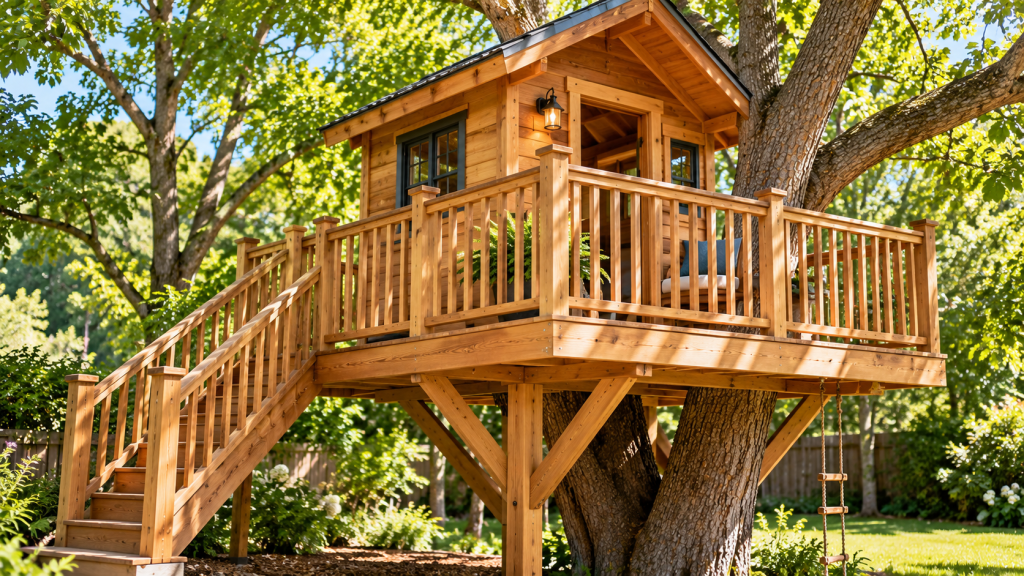
Frequently Asked Questions About Treehouse Railings
How tall should treehouse railings be for children?
Nationwide Children’s Hospital recommends solid treehouse barriers at least 38 inches tall. Measure from the finished standing surface, and check local building requirements and the platform’s structural design. A lower rail may appear sufficient for a small child, but children grow and may climb; height is only one part of effective protection.
Is wire mesh safe for a treehouse railing?
Wire mesh can form part of a protective enclosure only when its frame, openings, strength, and mounting are suitable for guarding. Some mesh patterns also provide footholds. Avoid relying on lightweight garden fencing, chicken wire, or loose netting as fall protection. A rigid, professionally assessed barrier is the safer choice.
Can I attach railing posts directly to the tree?
Do not add railing attachments directly to a living tree without a design that accounts for tree health, growth, movement, and the required loads. What works for a conventional deck may fail on a tree-supported platform. Have an experienced treehouse builder or structural engineer specify connections and consult an arborist where appropriate.
Are horizontal railings safe for young children?
Horizontal members can make climbing easier, especially when they resemble ladder rungs. For young children, solid walls or closely spaced vertical infill are usually better options. If you prefer horizontal styling, seek a guard design specifically evaluated for child access rather than assuming conventional deck aesthetics will translate safely to a play structure.
How often should I check a treehouse railing?
Check it before each play season, after major storms, and whenever the structure feels different underfoot. Test for movement without deliberately overloading the guard, inspect all exposed hardware, and confirm that gates latch. Any loose post, rotten wood, spreading gap, or damaged connector should keep the treehouse out of use until repaired.
Conclusion: Make Protection the Starting Point
The safest Treehouse Railings begin with the needs of the children using the space, not the view from the deck. Favor solid, difficult-to-climb barriers; keep openings small; and make sure every post and gate is securely integrated with the structural frame. Consider tree movement, weather exposure, and access points before settling on a material or style.
D&D gate hardware can help complete a properly framed entrance, but it cannot replace sound engineering, correct installation, or ongoing inspection.
For a family treehouse, the most useful final recommendation is simple: design the full protective enclosure first, then choose the components and finishes that fit it.