Treehouse Foundation Alternatives to Traditional Posts
We may earn a commission for purchases made using our links. Please see our disclosure to learn more.
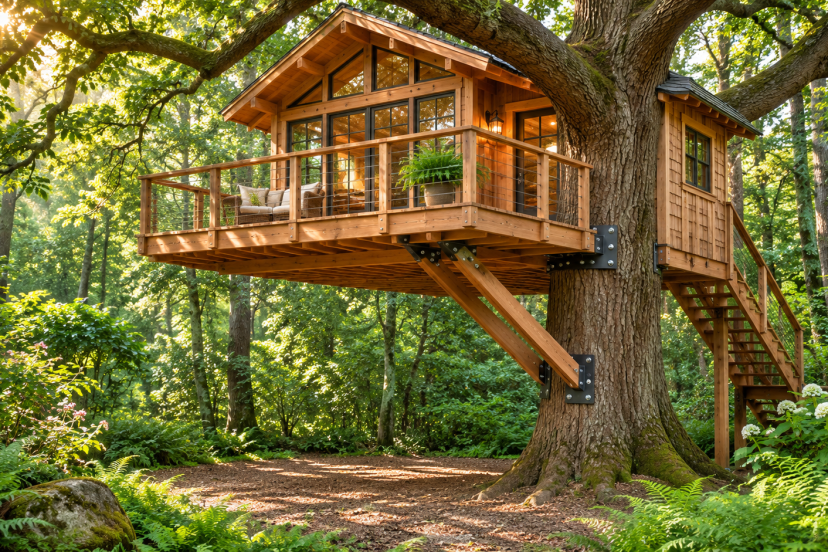
Tall wooden posts can make a treehouse look more like a raised garden shed than a hideaway among the branches.
A treehouse foundation doesn’t necessarily need to extend from the platform to the ground. Healthy, suitable trees can support platforms through engineered attachment bolts, diagonal braces, or suspension systems. Where trees cannot carry the entire structure, combining tree attachments with fewer ground supports may offer a workable compromise.
The right alternative depends on the tree’s condition, the intended size of the platform, and the way the structure will respond to wind and growth. Understanding these differences before buying lumber can prevent expensive design changes later.
How a Treehouse Foundation Works Without Traditional Posts
Every treehouse needs a continuous load path, meaning a reliable route through which forces travel from the structure into the ground. In a tree-supported design, the trunk and roots form part of that route instead of separate columns and footings.
The foundation must account for the weight of the building, occupants, furniture, and environmental forces such as wind and snow.
An elevated platform supported entirely by trees requires a site-specific structural design. Have an arborist assess the trees and an experienced structural engineer evaluate the proposed support arrangement.
Treehouse Attachment Bolts for Direct Tree Support
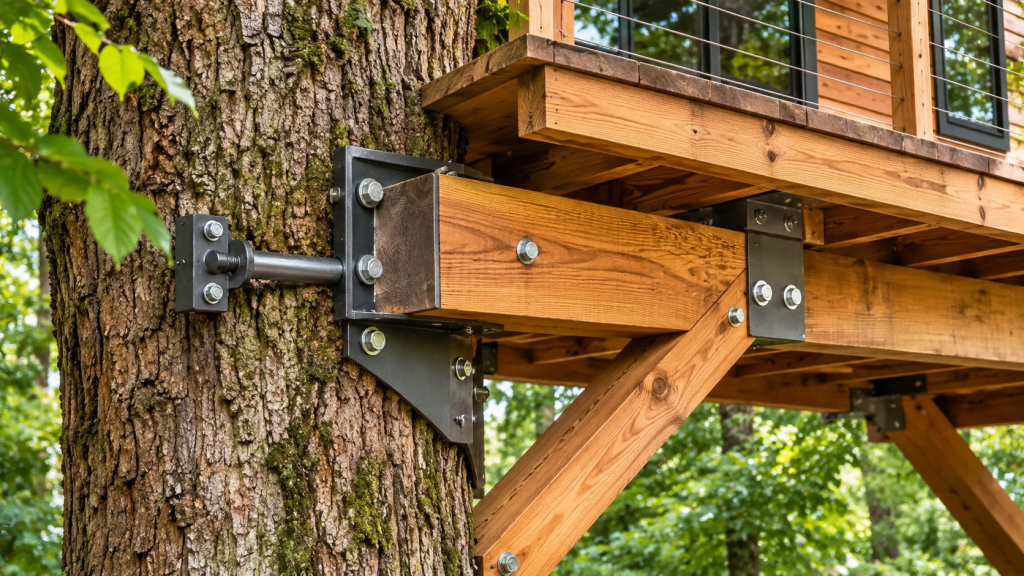
Treehouse attachment bolts, commonly called TABs, are specialized structural fasteners designed for supporting beams and other components from a living trunk. Their projecting sections provide attachment points for compatible brackets and framing.
A direct attachment system can leave the entire area underneath a treehouse open. It works particularly well as a design concept where a suitable mature trunk can accommodate a compact platform.
Published hardware capacities cannot be applied indiscriminately to different trees. Ordinary lag screws, deck screws, and general-purpose bolts are not equivalent substitutes for specified treehouse hardware.
Cantilevered Platforms With Diagonal Bracing
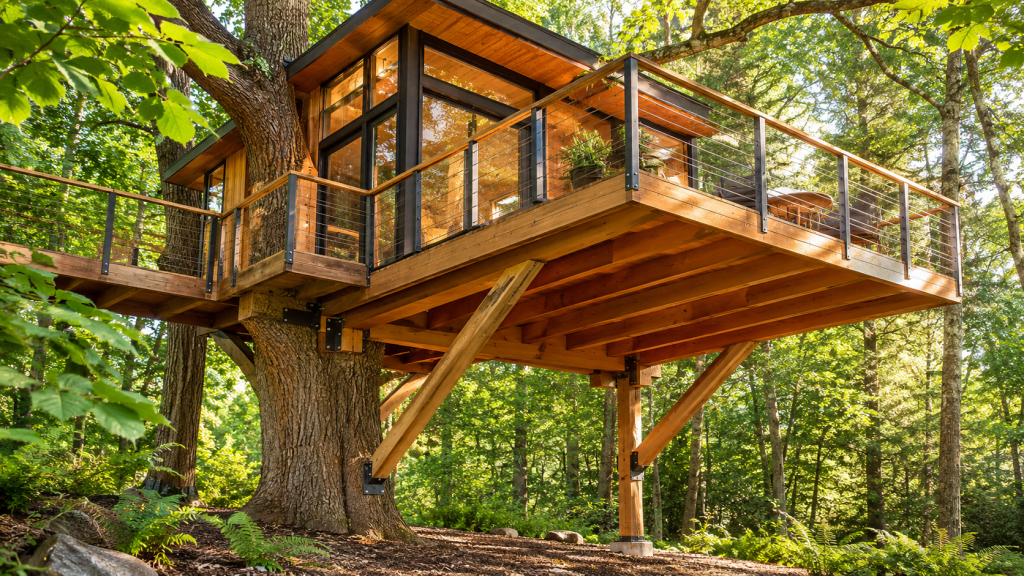
A cantilevered platform projects outward from its main support without requiring a ground post beneath its outer edge. Some designs incorporate diagonal knee braces extending between the platform framing and the trunk below.
Braced platforms are particularly worth discussing with a designer when the intended platform sits mainly on one side of a tree.
Longer projections increase the demands on the connections and supporting trunk. A small-looking balcony can create substantial leverage. The acceptable projection, brace geometry, and connection details must come from engineering rather than visual judgment.
Floating Brackets for Platforms Between Trees
A platform spanning separate trees needs to accommodate their independent motion.
Floating brackets are movement-accommodating connections that support framing while allowing controlled displacement. Depending on their design, they may permit travel in one direction or across a horizontal plane.
They are not complete foundations by themselves. The remaining connections must control unwanted movement, including uplift and sideways displacement. Ask the designer how the system will behave when trees move in different directions and whether the available bracket travel is adequate over time.
Cable-Supported and Suspended Treehouses
Suspension systems transfer some or all platform loads through engineered tension members to suitable tree attachment points above the structure.
Suspension is attractive for open decks and unusual layouts, but it introduces questions about sway, anchorage, fatigue, and corrosion. A cable’s advertised breaking strength alone cannot establish the capacity of an assembled support system.
Avoid wrapping ordinary ropes, chains, or wire directly around a growing trunk. Load-bearing suspension requires professional specification, including how connections will remain accessible for inspection and avoid damaging the tree.
Hybrid Foundations With Fewer Ground Supports
A hybrid foundation combines tree-supported framing with independent ground-supported elements. Instead of relying entirely on trees or surrounding the platform with columns, the designer distributes loads between the available supports.
This option can be useful when a tree is suitable for limited structural loads but the intended platform is too large for tree-only support.
The challenge is joining a moving tree to a comparatively stationary foundation. Those different movements must be considered throughout the design. Adding a post to an existing tree-supported platform without reviewing its connections can create unintended stresses.
Helical Piles and Ground Screws
Helical piles are steel foundation elements installed into soil by rotation. They can replace conventional excavated concrete footings in suitable engineered applications, supporting short columns or other structural members.
They do not eliminate above-ground supports automatically, but may reduce open excavation compared with poured footings.
Underground roots can still be damaged, and rocky soil or restricted equipment access may complicate installation. Use a professionally specified foundation system, not lightweight garden anchors. Have underground utilities located and agree on root protection before work begins.
Steel Frames and Independent Support Structures
An engineered steel frame can support a treehouse independently of the surrounding trees. This approach is useful when you want a platform nestled among branches but the trees are unsuitable for carrying additional loads.
Steel columns still require foundations, although the frame may offer different layout possibilities compared with conventional timber posts. The platform must remain clear of growing and swaying trunks.
Independent frames bring their own considerations, including fabrication costs, corrosion protection, connection design, and installation access.
Comparing Treehouse Foundation Alternatives
Start by deciding whether you want to eliminate posts completely or simply reduce their visual impact. Those goals lead to different designs.
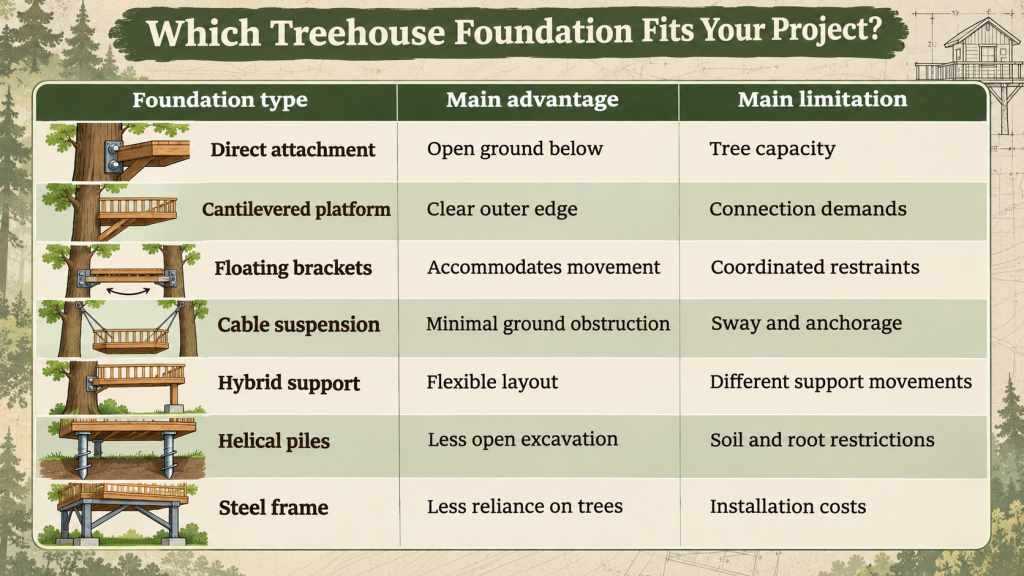
| Support option | Main advantage | Main limitation |
| Direct tree attachment | Open ground below | Depends on tree capacity |
| Cantilevered platform | Unobstructed outer edge | High connection demands |
| Floating bracket system | Accommodates tree movement | Requires coordinated restraints |
| Cable suspension | Minimal ground obstruction | Sway and anchorage complexity |
| Hybrid support | More layout flexibility | Different support movements |
| Helical piles | Less open excavation | Soil and root restrictions |
| Independent steel frame | Reduced reliance on trees | Fabrication and foundation costs |
Several methods can appear in the same engineered design; they are not mutually exclusive.
Assessing the Site Before Choosing a Foundation
Begin with the tree rather than the floor plan. Record the trunk dimensions, approximate spacing, ground slope, existing landscaping, and intended platform height.
Look for dead limbs, cavities, cracks, recent excavation, or signs of root disturbance. These observations help identify concerns but cannot replace an arborist’s assessment.
Before settling on a design, check local permit requirements, intended occupancy, and safe access. Understanding the broader process of planning and building a treehouse helps keep foundation decisions connected to the rest of the project.
Maintenance and Long-Term Foundation Stability
Growth can reduce clearances around framing, while storms can alter the condition of limbs and roots. Metal components can also corrode and timber can decay.
Arrange regular inspections according to the design and manufacturer’s guidance, with additional checks after severe weather. Keep connections visible and document changes in clearance, alignment, and hardware condition.
If you notice new cracking, loose components, unusual tilting, or damaged supporting trees, stop using the platform until it has been professionally assessed. Avoid tightening or repositioning movement-accommodating connections without understanding their intended function.
What Arboricultural Guidance Says About Tree Protection
The International Society of Arboriculture’s guidance on managing hazards and risk identifies construction-related root damage, compacted soil, and changes in drainage among the factors that can compromise tree health and stability.
Heavy equipment, stored lumber, and repeated traffic can affect the soil surrounding its supporting trees. Protecting the root zone should therefore begin before construction.
Specialist guidance from Treehouse Supplies on attachment bolts also explains that hardware selection depends on tree species and structural loading. Neither a healthy appearance nor a published bolt capacity establishes that a particular treehouse is safe. Arboricultural assessment and structural calculations address different parts of the problem, and both belong in the design process.
Recommended Products for Planning a Treehouse Foundation
These tools help with measurements, documentation, and preliminary layout. Purchase structural hardware only after the support design has been approved.
Crescent Lufkin W606PD 6-Foot Executive Diameter Pocket Tape Measure
Best for: Measuring tree trunk diameter and circumference
This compact tape measure features a double-sided blade that displays diameter and circumference measurements without manual calculations. Its durable metal case and spring-loaded retraction make it convenient for outdoor site assessments. The six-foot blade is suitable for measuring smaller trunks, although larger trees may require a longer forestry tape.
STANLEY FATMAX 33-725 25-Foot Classic Tape Measure
Best for: Measuring platform footprints and tree spacing
This retractable tape features a steel blade with protective coatings and a high-impact case. It is useful for recording distances between accessible points and checking dimensions against a preliminary drawing. Its fixed maximum length makes it less suitable for surveying wider sites, where a longer tape may be necessary.
Bosch BLAZE GLM100-23 100-Foot Laser Measure
Best for: Recording longer unobstructed distances
The GLM100-23 features a backlit display and a continuous measurement mode, making it convenient for gathering layout dimensions without extending a physical tape. Its specified maximum range is 100 feet, although outdoor light and irregular targets can affect measurements. Confirm critical readings using an appropriate independent measuring method.
Empire EM81.9 9-Inch Magnetic Torpedo Level
Best for: Checking small accessible framing components
This compact aluminum level includes separate vials for horizontal, vertical, and 45-degree references. Its magnetic edge is handy when working with compatible steel components. The short body fits into confined spaces, but a longer level or professional surveying equipment is more appropriate for checking alignment across an entire platform.
Rite in the Rain No. 973 All-Weather Side Spiral Notebook
Best for: Keeping site measurements and inspection records
The green spiral notebook contains 32 sheets of weather-resistant paper with a universal ruling suitable for notes and sketches. It provides a convenient place to record measurements and date observations during outdoor visits. Use it alongside photographs and approved drawings rather than treating informal field notes as structural documentation.
Frequently Asked Questions About Treehouse Foundations
Can a treehouse stand without any ground posts?
Yes, a suitably engineered tree-supported platform can stand without separate ground posts. Its feasibility depends on the tree’s condition, the expected loads, and the design of the attachments and framing. A treehouse that exceeds the available tree capacity needs a different support arrangement or a smaller footprint.
Is there a minimum tree diameter for a post-free treehouse?
There is no universal minimum diameter that guarantees a tree can support a treehouse. Species, internal wood condition, root stability, trunk shape, and proposed loading all influence suitability. Ask an arborist to evaluate the individual tree rather than relying on a diameter recommendation intended for a different project.
Can I replace existing treehouse posts with cables?
Only if a structural professional determines that the revised design can safely transfer the loads through the new suspension system. Removing existing posts changes how the platform behaves and can overload its remaining connections. Keep the original support system intact until an engineered modification and construction sequence have been established.
Are concrete-free foundations suitable for sloping yards?
They can be, depending on soil stability, drainage, access, and the design of the foundation. Engineered helical piles are one option worth investigating, but their suitability varies by location. Steep or potentially unstable slopes may require geotechnical assessment before the foundation type and position can be selected.
Which alternative is cheapest for a small treehouse?
There is no consistently cheapest alternative. Direct tree attachment may reduce ground foundation work, while specialized hardware, professional assessments, and installation can increase costs. Compare complete estimates for suitable designs, including engineering, labor, maintenance, and site preparation, instead of comparing only the price of posts and bolts.
Choosing the Right Foundation for Your Treehouse
A treehouse foundation should reflect what the site can support rather than what looks most appealing in a photograph. Direct attachments and braced platforms can preserve an open area below, while floating connections and suspension systems offer possibilities for more complicated tree arrangements. Hybrid designs and independent frames are worth considering when tree-only support is unsuitable.
Start with a modest platform footprint and a professional assessment of the trees. Basic measuring tools and a dedicated site notebook can make those early conversations more productive, without committing you to a particular construction method.
Before ordering structural hardware or removing existing supports, have the foundation design reviewed for loading, tree movement, and future maintenance. If the preferred design cannot meet those requirements, change the layout rather than compromising the support system.