
5 Non-Toxic Outdoor Paints For Your Treehouse

We may earn a commission for purchases made using our links. Please see our disclosure to learn more.
A treehouse should smell like timber, leaves, and maybe the snacks somebody forgot under a cushion—not like a paint aisle for three weeks. Choosing Non-Toxic Outdoor Paints can reduce unnecessary fumes while protecting the structure from sun, rain, muddy shoes, and young artists.
The tricky part is that non-toxic is not one universal technical standard. A paint may be water-based, low-VOC, recycled, or made with natural ingredients, yet still require ventilation and careful handling. This guide explains the labels, compares five practical options, and helps match a coating to your treehouse’s wood, exposure, and maintenance needs.
What “Non-Toxic” Outdoor Paint Really Means
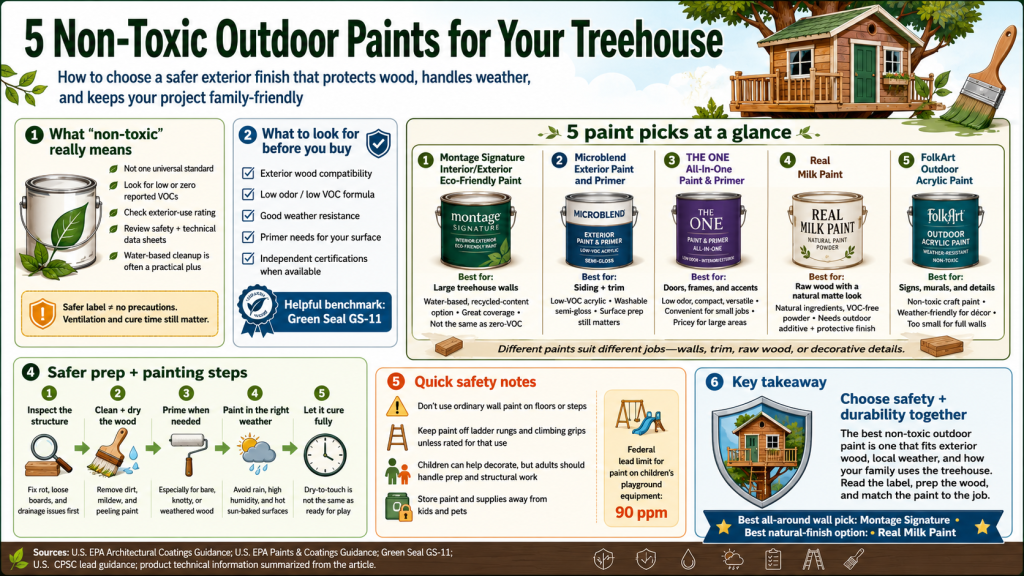
“Non-toxic” is usually a marketing description rather than a guarantee that a wet coating is harmless. A better approach is to look for specific, verifiable details: low or zero reported VOC content, water-based cleanup, disclosed ingredients, current safety data sheets, and independent certifications when available.
Also confirm that the product is rated for exterior use. A gentle interior paint can still peel or chalk outdoors. For a treehouse, safety and durability need to share the same branch.
Why Treehouses Need Exterior-Grade Protection
A treehouse faces expanding wood, UV exposure, rain, and damp shaded areas. Exterior coatings are formulated to tolerate those changes.
Still, no paint can rescue rotten boards, loose fasteners, or poor drainage. Paint is the raincoat, not the skeleton. Inspect and repair the structure first using these treehouse safety tips, and avoid coating climbing grips, ladder rungs, or floors unless the product is rated for that use.
How to Read Labels Without Getting Lost
Start with the intended surface and location. The label should name exterior wood, outdoor furniture, siding, trim, or a similar use. Then look for the VOC figure in grams per liter when the manufacturer provides it, rather than relying only on words such as “green” or “eco.”
Review the technical and safety data sheets for temperature, drying, recoating, and ventilation instructions. Check whether tinting changes the VOC level, because the finished colorant system may differ from the base. The EPA also notes that “low-VOC” is not a complete description of a coating’s chemical makeup.
5 Recommended Non-Toxic Outdoor Paints for Treehouses
These picks serve different jobs. Some suit full walls; others make more sense for doors, signs, murals, or bare wood.
| Product | Best use | Main limitation |
| Montage Signature Interior/Exterior Eco-Friendly Paint | Large wall areas | Recycled formula is not the same as zero VOC |
| Microblend Exterior Paint and Primer | Durable colored siding and trim | Surface preparation still matters |
| THE ONE All-In-One Paint & Primer | Doors, shutters, and small structures | Costly for a large treehouse |
| Real Milk Paint | Natural finish on raw porous wood | Needs an exterior additive and protective topcoat |
| FolkArt Outdoor Acrylic Paint | Decorative details and signs | Bottles are too small for full walls |
Montage Signature Interior/Exterior Eco-Friendly Paint, Dove Gray, Low Sheen, 5 Gallon
Best for: Covering a full-size treehouse on a practical budget
This water-based interior/exterior coating is made with recycled latex paint and comes in a large container suited to walls and siding. The low-sheen finish helps hide minor surface unevenness. It is a sensible waste-reducing choice, although “recycled” should not be confused with zero-VOC; use outdoor ventilation and follow the current label.
Microblend Exterior Paint and Primer, Saddle Horn, Semi-Gloss, 5 Gallon
Best for: Color-rich siding and trim that need regular cleaning
Microblend uses a water-based acrylic resin formula and is marketed as low-VOC, washable, and formulated with exterior UV protection. The semi-gloss finish suits trim, shutters, and areas touched often. Its paint-and-primer format can simplify a sound repaint, but bare, stained, weathered, or resinous wood may still require a dedicated primer.
THE ONE All-In-One Paint & Primer, Black Matte, 33.8 Fl Oz
Best for: Small treehouses, doors, frames, and bold accents
This water-based, low-odor, low-VOC coating is designed for indoor and outdoor use on surfaces including wood, metal, masonry, and plastic. Its compact size makes it handy for doors or trim without leaving a half-full bucket behind. The tradeoff is value: painting broad exterior walls with one-liter containers can become expensive quickly.
Real Milk Paint, Earth Green, 1 Pint
Best for: Bare wood and a traditional, natural-looking matte finish
Real Milk Paint is a powdered, water-mixed coating made from natural ingredients and reported as VOC-free. It works best on raw, absorbent wood. For outdoor use, the manufacturer recommends adding its Outdoor Additive and sealing the dry paint with Outdoor Defense Oil or another compatible exterior finish. That extra system adds labor but creates a distinctive, breathable appearance.
FolkArt Outdoor Acrylic Paint, Cerulean Blue, 2 Ounce
Best for: Child-designed signs, stencils, murals, and tiny details
FolkArt Outdoor Acrylic Paint is a water-based, non-toxic craft coating formulated for exterior decorative surfaces such as wood, stone, glass, and ceramics. Its self-sealing, weather-resistant formula is convenient for small creative touches. However, the two-ounce bottle makes it a detail paint, not a realistic choice for siding, floors, railings, or broad structural areas.
Match the Paint to the Wood You Have
Bare cedar, pine, plywood, pressure-treated lumber, and previously painted boards behave differently. Fresh pressure-treated wood may hold too much moisture for reliable adhesion. Follow the lumber supplier’s guidance and the paint maker’s moisture requirements.
Knots and tannin-rich woods may bleed through pale colors. In that case, use a compatible stain-blocking exterior primer. Previously painted wood needs scraping, feather-sanding, and a small adhesion test. If the old coating may contain lead, stop before sanding and use lead-safe procedures. Federal requirements limit lead in paint used on children’s playground equipment to 90 parts per million.
Choose a Color and Sheen That Age Gracefully
Dark colors can run hotter in direct sun, while vivid shades may show fading sooner. Mid-tone greens, browns, grays, and muted blues blend with foliage and disguise dirt.
Low-sheen or satin paint is forgiving on broad walls. Semi-gloss is easier to wipe and works well on doors and trim, though it highlights dents and rough grain. Avoid glossy coatings on steps or floors unless the system includes a suitable slip-resistant finish. A shiny ladder after rain is an unwanted adventure feature.
Research-Backed Guidance for Safer Paint Choices
The U.S. Environmental Protection Agency’s architectural-coatings guidance explains that coating VOC emissions contribute to ground-level ozone. Choosing a lower-VOC product can reduce emissions, but VOC content is only one part of the safety picture.
The EPA also warns in its paint and coating guidance for schools that low- or zero-VOC paints can still contain other undesirable compounds. Therefore, review the whole formula, not one badge.
For a stronger benchmark, the Green Seal GS-11 standard evaluates restricted chemicals, VOC limits, performance, and claims. The current GS-11 edition also addresses substances including heavy metals, certain solvents, and PFAS.
Meanwhile, the Consumer Product Safety Commission’s playground guidance states that coatings on children’s playground equipment must stay within the federal lead limit. A private treehouse is not automatically a certified playground product, but choosing compliant modern coatings is still a sensible baseline.
Prepare the Surface Before Opening the Can
Preparation quietly decides whether your project lasts. Wash away dirt, pollen, chalky residue, and mildew. Let the wood dry, then scrape loose paint and sand sharp transitions smooth.
Set protruding fasteners, replace soft boards, and use exterior-rated filler only for suitable non-structural defects. Remove dust before priming. Never paint over damp wood, active mold, or decay. Children can help with supervised cleaning, not scraping or sanding.
Pick a Weather Window, Not Just a Free Afternoon
Exterior paint needs a calm stretch of suitable weather. Check the label’s air and surface temperature limits, expected humidity, rain-free time, and overnight conditions. A sunny afternoon can still fail if evening dew lands before the film sets.
Avoid sun-heated wood because paint may dry too quickly to level. Follow the moving shade, and remember that wind can blow dust into wet paint and carry droplets surprisingly far.
Apply Thin, Even Coats
Close the lid between pours and give it a good stir. Brush end grain, joints, and edges first, then coat broader boards in manageable sections, following the grain where practical.
Two controlled coats usually produce a more reliable film than one heroic, sagging coat. Respect the listed recoat time, even when the surface feels dry. Keep paint away from hardware, tree bark, ropes, and moving connections. Never seal drainage gaps or places designed to flex.
Let the Finish Cure Before Play Resumes
Dry-to-touch and fully cured are not the same thing. A coating may stop feeling tacky within hours yet remain soft enough to dent, stick, or transfer under pressure. Follow the longest relevant cure time on the product label before letting children climb, lean furniture against walls, or hang decorations.
Ventilation still matters outdoors, especially inside an enclosed treehouse with small windows. Keep the door and windows open while painting and drying. Store leftover paint, brushes, oily rags, and additives where children and pets cannot reach them.
Maintain the Treehouse With Small Annual Checks
Inspect lower edges, window trim, roof intersections, and shaded sides once or twice a year. Small touch-ups beat stripping a neglected wall later.
Clean gently with mild soap and water unless the manufacturer recommends another method. Avoid aggressive pressure washing, which can damage wood fibers and force water behind boards. Record the product name, color, batch, and application date; your future self will be strangely grateful.
Common Mistakes That Shorten Paint Life
The biggest mistake is choosing an indoor paint that cannot handle weather. Others include painting damp wood, skipping cleaning, stretching one coat too far, and assuming “paint and primer” removes every need for primer.
Another common error is coating horizontal floors with ordinary wall paint. Walking surfaces need a product rated for foot traffic and slip resistance. Finally, do not treat “non-toxic” as permission to ignore gloves, ventilation, cleanup instructions, or curing time. Safer does not mean careless.
FAQs About Non-Toxic Outdoor Paints
Are zero-VOC and non-toxic paints the same?
No. Zero-VOC usually refers to a defined VOC-content threshold, while “non-toxic” may be a broader marketing claim. A zero-VOC coating can still contain preservatives, pigments, or other ingredients that concern some users. Compare the safety data sheet, certifications, exterior rating, and application instructions instead of judging the product by one phrase.
Can children help paint a treehouse?
Children can help with age-appropriate decorative tasks under close adult supervision, especially when using a water-based, non-toxic craft paint. Adults should handle ladders, structural inspection, sanding, scraping, primers, large-area coating, and cleanup. Keep children away from wet coatings until the manufacturer’s stated cure period has passed.
Do I need primer under Non-Toxic Outdoor Paints?
Sometimes. Sound, previously painted surfaces may accept a compatible self-priming coating, but bare wood, knots, tannin-rich boards, patched areas, major color changes, and weathered surfaces often benefit from a dedicated exterior primer. Use the paint maker’s recommended primer because mismatched systems can reduce adhesion or stain blocking.
Is milk paint durable enough for a treehouse?
It can be suitable for raw, porous wood when used as a complete exterior system. Real Milk Paint recommends an outdoor additive and a compatible protective oil or topcoat. Without that protection, the porous finish can absorb water and weather more quickly. It is better for a natural, maintainable look than a maintenance-free promise.
How often should a painted treehouse be recoated?
There is no universal schedule. Sun exposure, rainfall, wood movement, color, surface preparation, and coating quality all affect service life. Inspect annually and touch up exposed areas promptly. Recoat when the film begins to chalk, crack, lose adhesion, or expose wood rather than waiting for widespread peeling.
Final Recommendation: Choose Safety and Durability Together
The best Non-Toxic Outdoor Paints are not simply the products with the gentlest label. They must also suit exterior wood, local weather, the existing surface, and the way your family uses the treehouse. Montage Signature is a practical choice for broad coverage with recycled content, while THE ONE works neatly for doors and smaller details. For raw wood and a traditional matte character, Real Milk Paint is appealing when paired with its recommended outdoor additive and protective finish.
Whatever you choose, read the current technical documents, prepare the wood carefully, apply the full system, and allow a proper cure. That patient work matters more than any cheerful claim on the front of the can.