Best Telescope for Kids for Backyard Adventures
We may earn a commission for purchases made using our links. Please see our disclosure to learn more.
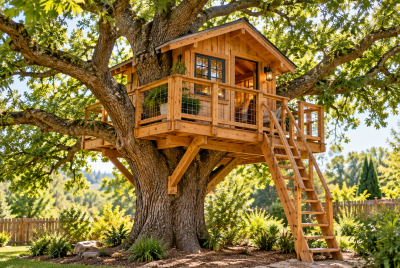
A treehouse already has that magical “secret clubhouse” feeling. It is part hideout, part lookout tower, part imagination machine. Add a telescope for kids, and suddenly that little wooden space becomes a moon-watching station, bird-spotting deck, pirate lookout, and backyard science lab all rolled into one.
The hard part is choosing a telescope your child will actually enjoy using. Some look impressive online but feel like you need a NASA badge just to set them up. Others are cute and colorful but too limited to hold a curious child’s attention for long.
This guide will help you choose a beginner-friendly telescope, set it up safely around a treehouse, and create simple stargazing moments your family can enjoy without stress.
Why a Treehouse Makes Stargazing Feel Special
A treehouse gives kids something ordinary backyards often cannot: a sense of adventure. Even a small platform tucked between branches can feel like a private observatory when the sky gets dark.
You don’t need a fancy setup either. Sometimes the best memory starts with a blanket, a flashlight, and someone whispering, “Look at the Moon tonight.”
The American Museum of Natural History encourages young skywatchers to use tools like sky maps, notebooks, binoculars, and telescopes to identify stars, planets, and constellations more clearly. That is a wonderful reminder that astronomy does not have to feel complicated. It can begin with simply looking up.
What Makes a Good Telescope for Kids?
A good telescope for kids should feel easy, sturdy, and rewarding. Kids are naturally curious, but they are not usually patient with gear that takes forever to adjust. Honestly, many adults are not either.
The biggest mistake is chasing high magnification. A shaky telescope with a huge magnification claim can be frustrating because every little movement makes the image jump around. It’s like trying to read a book on a rough bus.
Stability matters more than flashy numbers.
Start With the Moon Before Looking for Planets
The Moon is the perfect first target. It is bright, easy to find, and full of details kids can recognize right away. Craters, shadows, and changing phases make it feel alive, almost like the Moon has a different personality every few nights.
NASA’s skywatching hub offers monthly tips, skywatching guides, and beginner-friendly resources for families who want to explore the night sky with simple tools.
Start with the Moon, then slowly move to bright planets, star clusters, and familiar constellations. That gentle progression keeps the experience fun instead of overwhelming.
Safety First: Treehouse Stargazing Rules
A treehouse and a telescope can be a wonderful combination, but safety needs to come first, especially at night.
Before you bring out the telescope, set a few simple ground rules. Kids should not lean over railings, climb with equipment in hand, or move around in the dark without adult supervision. Use soft, safe lighting so everyone can see where they are stepping.
Also, never let children point a telescope at the Sun unless the telescope has a proper solar filter designed for that exact purpose. Regular sunglasses, tinted plastic, smoked glass, or quick peeks are not safe. Eye damage can happen quickly, so this rule is non-negotiable.
Best Telescope Types for Young Explorers
Not every telescope works the same way. Some are better for kids because they are easier to aim, carry, and understand.
Refractor Telescopes
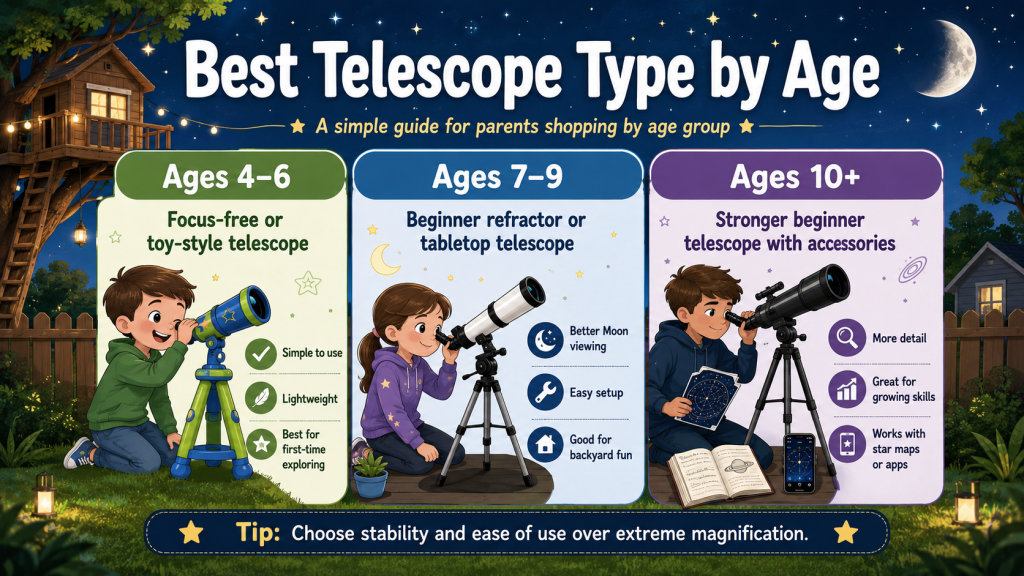
Refractor telescopes are popular for beginners because they look like the classic telescope most people imagine. They are often simple to use and can work for both nighttime sky viewing and daytime nature watching.
That makes them helpful if your child wants to look at the Moon one night and birds in the trees the next morning.
Tabletop Telescopes
Tabletop telescopes sit on a table, bench, or flat platform. They can be easier for kids because they often feel steadier than lightweight tripods.
For treehouse use, a tabletop model may work well if the platform is very stable. If the treehouse shakes, though, set the telescope on the ground nearby.
Toy-Style Starter Telescopes
Toy-style telescopes are best for very young kids. They may not show as much detail, but they are easier to handle. For preschoolers, that matters.
A child who feels successful is more likely to stay interested. A child who spends 20 minutes trying to focus a blurry dot may be done with astronomy before snack time.
Where to Set Up the Telescope Around a Treehouse
Choose the flattest and most stable spot available. Avoid placing the telescope near ladders, rail openings, trapdoors, loose boards, or busy walkways.
If your treehouse moves when kids walk around, use the treehouse as the “space club” hangout and place the telescope on the ground. That way, kids still get the adventure feeling without trying to balance delicate gear on a wobbly platform.
A small folding table near the treehouse can also work well. Add a notebook, pencil, red flashlight, and warm blanket, and you have a simple backyard astronomy station.
Quick Buying Checklist
Before buying a telescope for kids, pause and ask a few practical questions.
- Can my child help carry it safely?
- Can we set it up in under 10 minutes?
- Is the base or tripod stable?
- Does it include eyepieces?
- Does it include a finder scope?
- Is it good for the Moon, planets, birds, or all-around exploring?
- Can we store it safely when we are done?
That last question sounds boring, but it matters. Lens caps and small eyepieces have a talent for disappearing into the same mysterious universe as missing socks.
5 Amazon Picks for a Telescope for Kids
Here are five beginner-friendly options that can work well for backyard viewing, treehouse adventures, camping trips, and family stargazing nights.
Celestron National Park Foundation FirstScope Telescope
The Celestron National Park Foundation FirstScope is a compact tabletop Newtonian telescope with a 76mm primary mirror. It is portable, lightweight, and simple enough for casual family skywatching.
Its wide-field view makes it a nice choice for scanning the night sky, looking at the Moon, and introducing kids to basic astronomy without a complicated setup.
Features:
- Tabletop design
- 76mm mirror
- Wide-field viewing
- Lightweight body
- Simple beginner setup
Best for: Kids who want a first telescope for backyard Moon nights, family stargazing, and relaxed exploring.
Gskyer Telescope, 70mm Aperture 400mm AZ Mount Astronomical Refracting Telescope for Kids Beginners
This Gskyer telescope is a more complete starter kit for kids who are ready for a little more control. It includes a 70mm aperture, 400mm focal length, replaceable eyepieces, a 3x Barlow lens, and a finder scope to help locate objects.
It is a good middle-ground option: not too advanced, but not so basic that your child outgrows it immediately.
Features:
- 70mm aperture
- 400mm focal length
- Two eyepieces
- 3x Barlow lens
- Finder scope
Best for: Older kids, beginners, and families who want a more traditional telescope experience.
NASA Lunar Telescope for Kids – 90x Magnification
The NASA Lunar Telescope is designed with young Moon watchers in mind. It includes low- and high-power eyepieces, a finder scope, tabletop tripod, dust cap, and learning guide.
Because it focuses heavily on lunar viewing, it is a friendly first step for kids who want to see craters and Moon details without needing a large telescope.
Features:
- 90x magnification
- Tabletop tripod
- Finder scope
- Learning guide
- Kid-focused design
Best for: Younger space fans who are most excited about exploring the Moon.
Educational Insights GeoSafari My First Telescope
The Educational Insights GeoSafari My First Telescope is designed for younger children, especially ages 4–8. It has a focus-free design, which means kids can start exploring without constantly adjusting knobs.
That simplicity is the whole charm. It may not satisfy an older child who wants detailed planet views, but it is great for little explorers who just want to look, point, and discover.
Features:
- Kid-sized body
- Focus-free design
- No batteries required
- Easy outdoor use
- Beginner-friendly handling
Best for: Preschool and early elementary kids who need a simple, frustration-free first telescope.
Celestron Travel Scope 70DX Portable Refractor Telescope
The Celestron Travel Scope 70DX is a portable refractor telescope made for families who like to explore in more than one place. It includes fully coated glass optics, a backpack, finder scope, star diagonal, eyepieces, smartphone adapter, Bluetooth remote, Barlow lens, and Moon filter.
It is especially useful if you want one telescope for the backyard, camping trips, park nights, and travel.
Features:
- 70mm aperture
- Backpack included
- Smartphone adapter
- Bluetooth remote
- Moon filter
Best for: Families who want a portable telescope that can move easily from backyard nights to weekend adventures.
Research-Backed Reasons Stargazing Is Worth It
Stargazing is more than a sweet backyard activity. It can support curiosity, patience, observation skills, and family connection.
A 2024 Australian Institute of Family Studies review on nature play and child wellbeing notes that nature play may support children’s physical and mental health, learning, confidence, resilience, social interaction, and family connection.
That does not mean a telescope magically turns every child into a scientist by Friday. But it does create a space where kids can ask questions, slow down, notice details, and share wonder with someone they trust.
For product guidance, Space.com’s expert reviewers mention that the Celestron FirstScope 76 is designed for children and beginners, arrives assembled, and is light enough to move around the home or take on trips.
How to Make the First Night Feel Easy
Do not overplan the first stargazing night. A grand “we are now studying the universe” announcement can make the whole thing feel like homework wearing a cape.
Keep it simple.
Pick a clear night. Start before everyone is tired. Look at the Moon first. Use one eyepiece at a time. Let kids take turns. And most importantly, keep expectations low and wonder high.
A five-minute “wow” moment is better than an hour of frustrated adjusting.
You can also make it cozy. Bring a blanket, a warm drink, or a small snack. Let kids draw what they see. If they call a crater a “moon pothole,” let it happen. That is adorable and honestly not a bad description.
Storage Tips for Treehouse Astronomy Gear
A telescope should not live outside full-time. Moisture, dust, bugs, and temperature changes can damage the optics and make the telescope harder to use.
Store it indoors when you are done. Keep eyepieces, lens caps, filters, and small accessories together in a labeled pouch or storage bin.
If your treehouse also holds books, binoculars, blankets, journals, or nature tools, these smart treehouse storage ideas can help keep the space organized instead of turning it into a tiny wooden junk drawer.
A tidy treehouse makes adventures easier to start. Nobody wants to begin stargazing by hunting for one missing eyepiece under a pile of old chalk and snack wrappers.
FAQs About Buying a Telescope for Kids
What is the best telescope for kids who are beginners?
The best beginner telescope is usually a simple refractor or tabletop model with a stable base, easy focusing, and good Moon viewing. For younger kids, a focus-free starter telescope may be the better choice because it reduces frustration.
Can kids use a telescope from a treehouse?
Yes, but only with adult supervision and a safe setup. Keep the telescope away from edges, ladders, trapdoors, and shaky boards. If the treehouse moves too much, place the telescope on the ground nearby and use the treehouse as the cozy viewing hangout.
What can kids see with a beginner telescope?
Kids can usually see the Moon, bright stars, some planets, and daytime objects like birds or treetops. Stronger beginner telescopes may show more detail, but clear skies and a stable setup make a big difference.
Is a telescope or binoculars better for young kids?
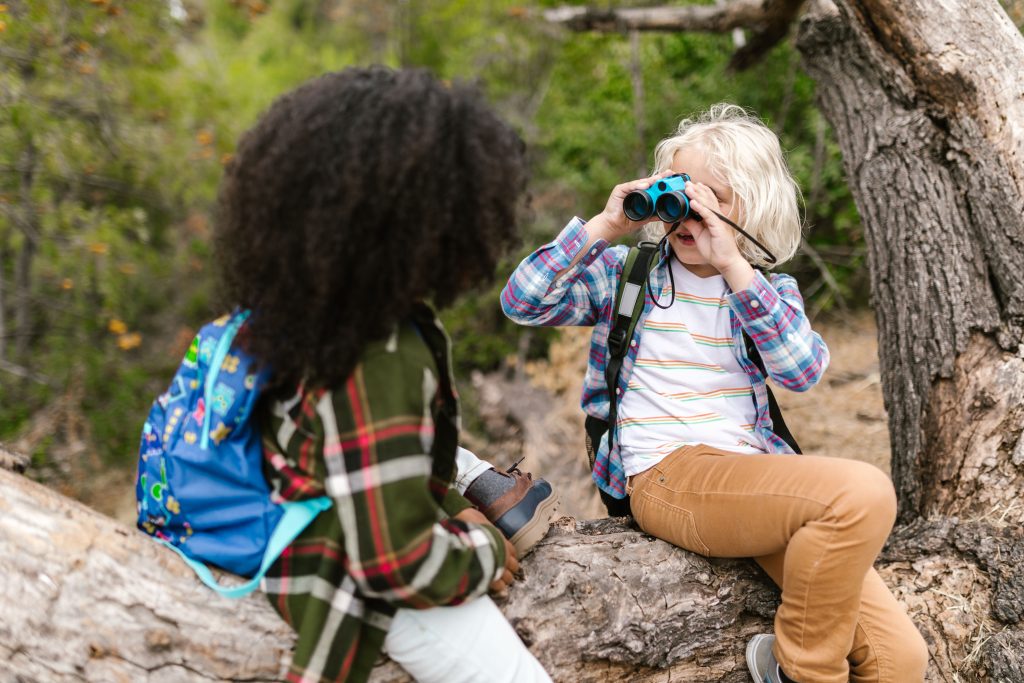
For very young kids, binoculars or a focus-free telescope may be easier. For older kids who are excited about astronomy, a beginner telescope usually offers more room to grow and more exciting Moon-viewing moments.
How do I keep a kids telescope from getting damaged?
Store it indoors, keep the lens caps on, and place small accessories in a pouch or labeled container. Teach kids to carry one piece at a time and avoid touching the glass. Sticky snack fingers and telescope lenses are not best friends.
Conclusion
Choosing the best telescope for kids is not about finding the biggest or fanciest model. It is about choosing something your child can use, enjoy, and come back to again.
A treehouse adds adventure. The telescope adds focus. The night sky adds wonder.
Start with the Moon. Keep the setup safe. Choose a telescope that matches your child’s age and patience level. Then let curiosity do what it does best.
One quiet backyard night could become the memory your child talks about years later: “That was the first time I saw the Moon up close.”