5 Treehouse Railing Ideas for Safety & Style
We may earn a commission for purchases made using our links. Please see our disclosure to learn more.
A treehouse railing has two jobs: help protect people from a fall and look like it belongs with the structure. That balance is why choosing among Treehouse Railing Ideas can take more thought than expected. Wood balusters feel classic, black metal keeps sightlines open, mesh suits rustic builds, and clear panels preserve the view.
This guide compares five practical approaches, explains the safety details that matter most, and highlights hardware and material choices that affect the finished railing. You will also find product options for builds, plus research-backed guidance to help you decide before cutting or fastening anything.
Affiliate disclosure: Some links in this article may be affiliate links. If you buy through them, the site may earn a commission at no extra cost to you.
What Makes Treehouse Railing Ideas Safe Enough for Kids?
Good Treehouse Railing Ideas begin with structure, not decoration. Attractive infill cannot compensate for loose posts, weak framing, oversized openings, or a top rail that flexes.
Treat the railing as one system: posts, rails, infill, fasteners, and supporting framing. Before you focus on style, review the site’s treehouse safety tips and inspection checklist so the platform, access route, and existing posts get the same attention as the new railing.
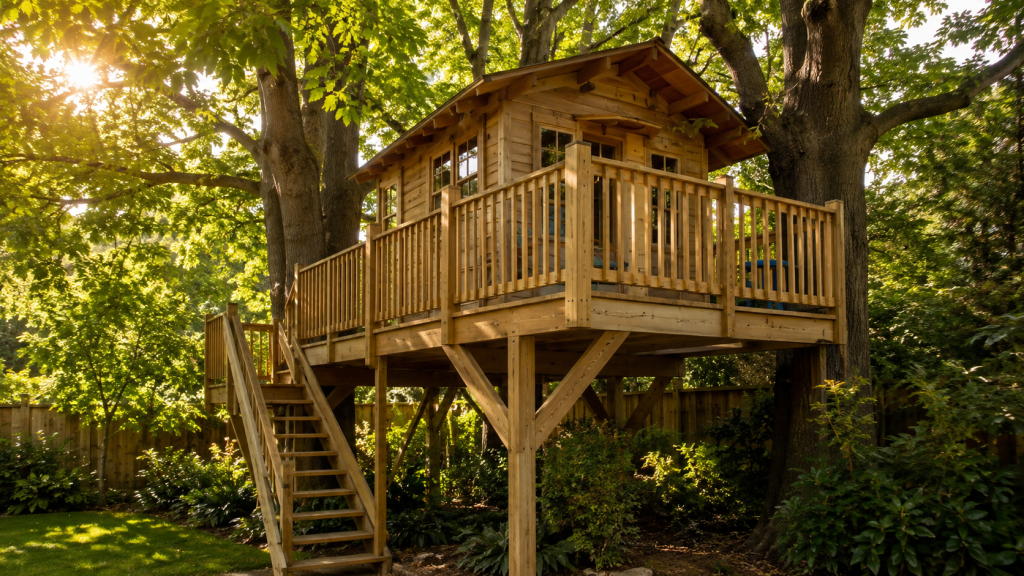
Treehouse Railing Idea #1: Classic Vertical Wood Balusters
Vertical wood balusters are familiar Treehouse Railing Ideas because they match timber platforms and are easy to customize. Square pickets feel simple, while rounded edges and a contrasting top rail add polish.
Keep spacing consistent and attach each piece securely. Vertical members also provide fewer obvious footholds than horizontal “ladder-like” rails for young climbers. Sand exposed edges and maintain the outdoor finish as the wood weathers.
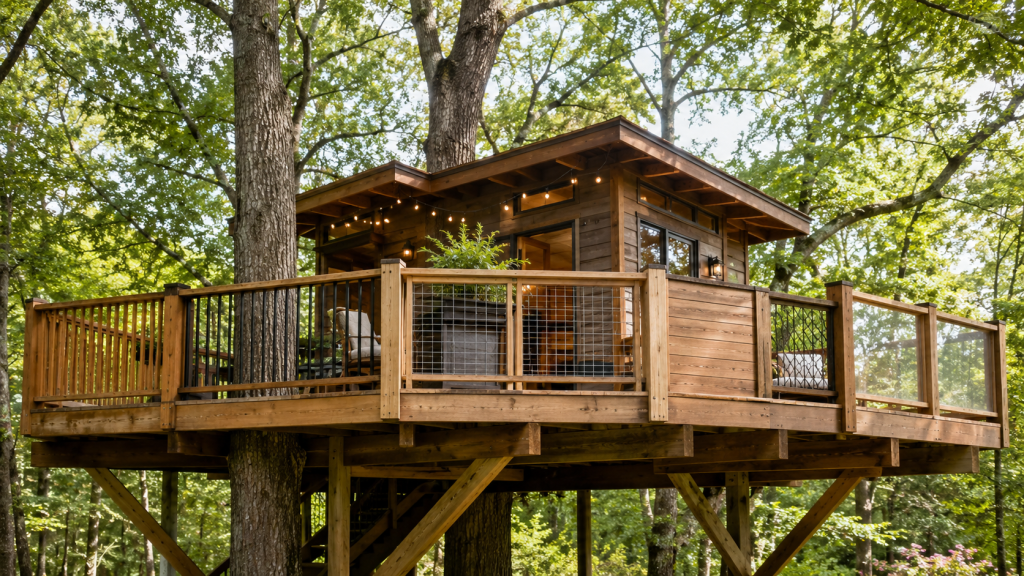
Treehouse Railing Idea #2: Black Metal Balusters
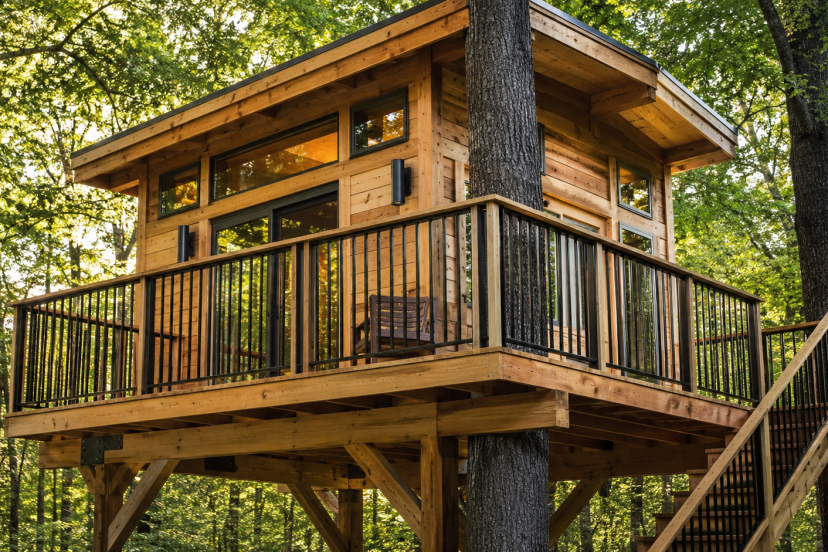
Black metal balusters create a clean look without blocking much of the view. They pair especially well with cedar or pressure-treated lumber and can make a simple platform feel more finished.
Among modern Treehouse Railing Ideas, they also reduce how much wood needs refinishing. Still, the wood rails and posts remain critical. Check baluster length, connector requirements, final guard height, and opening sizes before buying.
Treehouse Railing Idea #3: Framed Welded-Wire Panels
Welded wire creates a light woodland look while preserving visibility, especially on larger platforms where solid boards can feel enclosing.
For this version of Treehouse Railing Ideas, use mesh only as infill. Frame every edge, cover cut wire ends, and prevent the panel from bowing outward. Small openings can help reduce some hazards, but sturdy posts, rails, fasteners, and appropriate local review still matter.
Treehouse Railing Idea #4: A Solid Wood Half-Wall
A solid wood half-wall offers privacy and can make a higher platform feel more enclosed. Exterior-rated panels or closely fitted outdoor boards create a barrier with few openings.
This is one of the easiest Treehouse Railing Ideas to personalize with trim or paint. However, a solid surface catches more wind and can trap moisture. Plan drainage and ventilation, protect cut edges, and make sure the supporting frame can handle the panel rather than treating it like decoration.
Treehouse Railing Idea #5: Clear Polycarbonate Panels
Clear polycarbonate preserves the “up in the trees” view while creating a visually enclosed barrier. It can also make supervision easier because adults can see through the perimeter.
Clear-panel Treehouse Railing Ideas need careful detailing. Sheet thickness, edge support, hole placement, thermal movement, and mounting hardware all matter. Protect edges, follow manufacturer drilling guidance, and never assume a general-purpose sheet automatically qualifies as a guardrail system.
How High Should Treehouse Railings Be?
There is no single universal treehouse railing height. Rules vary by jurisdiction, and a backyard treehouse may be treated differently from a residential deck or play structure.
As a reference point, the 2024 International Residential Code requires guards on certain open-sided residential walking surfaces more than 30 inches above the floor or grade and generally sets a 36-inch minimum guard height there. That does not automatically make 36 inches correct for your treehouse. Check local requirements and consider who will use the platform.
Spacing Openings to Reduce Entrapment Risk
Spacing matters almost as much as height. An opening can create a fall, entrapment, or climbing hazard depending on its size and orientation.
Current U.S. Consumer Product Safety Commission playground guidance addresses both openings and entrapment, although it is not a residential treehouse code. For home Treehouse Railing Ideas, favor small, consistent openings and avoid decorative gaps that widen near corners, stairs, or uneven framing. If children will use the structure, have uncertain dimensions reviewed before building.
How to Attach Railing Posts Securely
The post connection is easy to overlook, yet it carries important railing loads. A few ordinary screws through a post into the edge of a board are not a substitute for a properly detailed connection.
Use hardware and fasteners that match the joint, lumber, exposure, and manufacturer instructions. Simpson Strong-Tie, for example, publishes for guard-post applications. If your treehouse framing differs from the documented installation, ask a qualified local builder or engineer how to create a suitable load path.
Choosing Materials That Survive Outdoor Exposure
Rain, sun, temperature swings, and debris can punish outdoor joints that looked perfect on build day.
Choose exterior-appropriate lumber, coatings, connectors, and fasteners, with metal compatibility considered for treated lumber. Also keep critical connections visible enough to inspect. The best Treehouse Railing Ideas make it practical to spot movement, corrosion, cracked wood, or decay before small problems become structural ones.
Recommended Products for Treehouse Railing Ideas
These five products cover metal infill, mesh, clear panels, structural screws, and post-connection hardware. None is a complete treehouse guard system by itself.
Sidasu 25 Pack 32″ Metal Deck Balusters for Deck, Porch and Stair Railings | Galvanized Carbon Steel, Rust & Weather Resistant, Side-Mount Design, End Caps and Mounting Screws Included, for Outdoor Use
Best for: A modern black-metal look with included mounting hardware
This set includes 25 32-inch galvanized carbon-steel balusters with a side-mount design, end caps, and mounting screws. It is convenient for builders who want a slim black profile without sourcing every small mounting piece separately. However, the product is a railing component, not a complete treehouse guard, so verify the finished height, spacing, framing, and local requirements.
Fencer Wire 16 Gauge Black Vinyl Coated Welded Wire Mesh Size 1 inch by 1 inch for Home and Garden Fence and Pet Enclosures Protect Chickens Rabbits and Farmed Animals (d) 4 ft. x 50 ft.
Best for: Rustic framed-mesh railings on a budget-conscious build
This 4-by-50-foot roll uses 16-gauge galvanized wire with black vinyl coating and 1-inch-square openings. It provides ample material for custom framed panels while preserving visibility. The limitation is important: it is fencing, not an engineered guardrail system, so every edge, support, and connection needs deliberate framing and project-specific verification.
Clear Polycarbonate Sheet 24″ x 36″ (1/2″ Thick) | Stronger Than Plexiglass Sheets, UV, Impact, Weather Resistant, Sizes Nominally Cut +-1/8″, Made in USA
Best for: Clear-view custom infill concepts
This Spectra Glass sheet measures 24 by 36 inches and 1/2 inch thick, with clear, weather-resistant polycarbonate construction. It suits builders exploring transparent infill where sightlines matter. Because it is a general-purpose sheet rather than a railing kit, mounting, edge restraint, fastener spacing, and suitability for guard use require project-specific verification.
GRK Fasteners RSS™ 5/16 x 4″ Rugged Structural Framing Screws, 100 PCS
Best for: Wood connections that specifically call for structural screws
This pack contains 100 structural screws sized 5/16 by 4 inches, a useful quantity for larger outdoor builds. Their practical value comes when a verified connection detail specifies this fastener type and size. Do not automatically substitute them for bolts, nails, or proprietary connector fasteners; correct fasteners depend on the joint and hardware instructions.
Simpson Strong-Tie DTT2Z-20 Deck Tension Tie 20 Pack – ZMAX Galvanized 14-Gauge, dtt2z Deck Tension Ties
Best for: Reinforced guard-post connections using documented Simpson details
This 20-pack contains DTT2Z ZMAX galvanized 14-gauge deck tension ties. Simpson Strong-Tie publishes technical guard-post applications for the DTT2, making it relevant when your framing matches a documented detail. It is not a universal fix for every treehouse post; use the specified companion fasteners and installation method instead of adapting the connector by guesswork.
| Product | Main role | Best fit |
| Sidasu black balusters | Vertical infill | Modern wood-and-metal look |
| Fencer Wire mesh | Framed infill | Rustic, open sightlines |
| Spectra Glass polycarbonate | Clear infill | Maximum visibility |
| GRK RSS screws | Fastening | Specified wood joints |
| Simpson DTT2Z ties | Post connection | Reinforced assemblies |
Research-Backed Safety Guidance for Treehouse Railings
Treehouse-specific injury evidence is limited, but fall prevention clearly deserves attention. A 2009 estimated 47,351 U.S. emergency-department-treated treehouse injuries among people age 19 or younger from 1990–2006; falls caused 78.6%. Because the data are historical and observational, they do not prove that one railing style is safest.
For current context, the CPSC’s 2025 Public Playground Safety Handbook recommends guardrails or protective barriers on elevated playground surfaces and addresses entrapment. ASTM F1487-25 also covers public playground equipment, but explicitly excludes home playground equipment. These sources help identify hazards; they do not establish that a backyard treehouse complies with a public-playground standard.
The offer another residential reference point, while local rules decide what actually applies. Combine these sources with manufacturer instructions and professional advice when height, framing, or post connections create uncertainty.
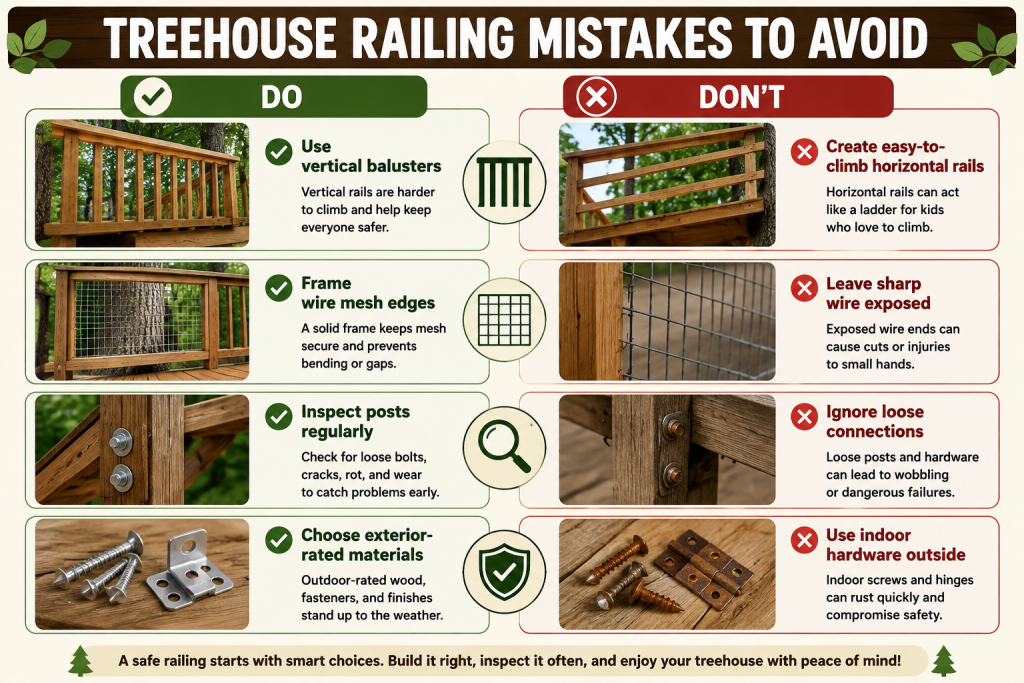
Common Treehouse Railing Mistakes to Avoid
A common mistake is choosing attractive infill first and figuring out the posts later. Establish the structure first, then choose infill that fits it.
Avoid wide decorative openings, exposed wire ends, climbable horizontal patterns for young users, untreated cut edges, and hardware selected only because it looks heavy-duty. Good Treehouse Railing Ideas also allow inspection, so movement, corrosion, decay, or loosened hardware is easy to spot.
FAQs About Treehouse Railing Ideas
What is the safest railing style for a kids’ treehouse?
No single style is automatically safest. A vertical-baluster, framed-mesh, solid-panel, or clear-panel guard can reduce hazards when posts, openings, height, fasteners, and framing are properly designed. For younger users, favor designs that limit footholds and large openings, then verify dimensions against local requirements and guidance relevant to your structure.
Are horizontal railings a good idea for a treehouse?
Horizontal rails can look attractive, but they may act like ladder rungs for children who enjoy climbing. That makes them less appealing for many family treehouses. If you want horizontal lines, consider creating the visual effect outside a non-climbable protective barrier rather than making the guard itself easy to scale.
Can I use wire mesh for a treehouse railing?
Yes, wire mesh can serve as infill in a carefully framed custom railing, but ordinary fencing is not a complete guard system. Choose small, consistent mesh, secure every edge, cover cut ends, and provide rigid posts and rails. Because fencing products are not necessarily tested as guards, verify the finished assembly for your treehouse.
Is polycarbonate better than wood for Treehouse Railing Ideas?
Neither is universally better. Polycarbonate preserves views and reduces large visual gaps, while wood integrates easily into traditional treehouse frames and is repairable with common tools. Clear panels require careful edge support and mounting; wood needs weather protection and inspection for decay. Choose the material whose installation and maintenance you can manage correctly.
How often should I inspect a treehouse railing?
Inspect it regularly and after events that could loosen or damage the structure, such as severe storms, falling branches, or major seasonal movement. Look for loose posts, corroded fasteners, cracked boards, rot, sharp edges, widening gaps, and moving panels. The right interval depends on climate, materials, use, and manufacturer guidance.
Final Recommendation on Treehouse Railing Ideas
The best Treehouse Railing Ideas combine a secure structure with an infill style you can inspect and maintain. Vertical wood suits traditional builds, black metal gives a cleaner modern look, framed mesh keeps views open, solid panels add enclosure, and clear polycarbonate preserves sightlines.
Start with post strength, opening sizes, height, and a clear load path before choosing decorative details. Sidasu balusters can simplify a consistent metal-infill look, while Simpson DTT2Z hardware can help when your post connection matches the manufacturer’s documented application. For a family treehouse, choose the simplest design you can build correctly, verify locally, and maintain confidently over time.